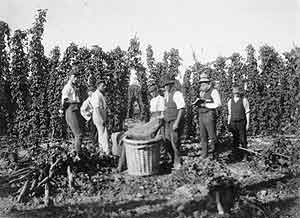
| Lilian Smither wrote in 1962 about hop picking in Froyle some 50 years earlier. | ||
Hop picking was such a busy
time in our family for many years, grandfather, uncle and father
all grew hops on their separate farms. They employed the same
pickers, always home pickers (people living in our village, Froyle,
near Alton) and so we knew them all. Grandfather’s hops were
picked first, then uncle’s and last, my father’s. The three farms
were adjoining.  Even my step-grandmother went into the hop gardens and she, poor soul, had come from London about the year 1902, and knew little or nothing of hop picking. But she braved all weathers; those misty September mornings are not easily forgotten. Mostly the weather was fine and sunny, but there were wet days and that meant mud and more mud. No wonder she was soon crippled with rheumatism. But it is not my intention to talk of Grandmother, but of hop picking. Whole families went into the gardens - babies in prams, toddlers and school children of all ages. Many old folk wouldn’t have missed the hop picking season for anything. The pickers were mostly women and children, the menfolk of the village being occupied with their various jobs. The hops were always picked during the school summer holidays and it certainly gave the children something to do. Even my mother, with a family and a busy farmhouse to control, would spare a certain amount of time each day for the hop gardens, and we children went too. We were expected to pick hops and not play around, but we had our fun. It was quite a thrill to sit on a small stool and fill an upturned umbrella with the hops, gradually covering the wires and then emptying them into the big bin and start the process all over again. These bins were made of strong canvas attached with nails to a wooden frame and the hops grew on poles. Grandfather and his sons never changed their method of hop growing to the modern way with string. Pole pullers were kept busy and would walk backward and forwards pulling the poles with a fag-hook for the pickers, who put the poles across the bins. These bins held 7 bushels and were emptied from time to time, the tally man keeping a strict account of the bushels each family picked. The secret of a good day's picking was an early start at 6.30 or 7 a.m., finishing at about 5 p.m. Leaves would fall in the bins and these had to be picked out again as they spoilt the samples for the hop buyers. A welcome visitor to the hop gardens was the local baker with his basket of buns of all sorts and sizes, and the lucky ones with pence to spare enjoyed them for lunch. Dinner was often eaten in the gardens, with hands half black with the stain of the hops and oh, what a bitter taste was mingled with the sandwiches, pies, apples. After a busy day what a delight it was to wash your hands at the old fashioned brick sink in the farm kitchen and sit down with the family to a fish supper, herrings or bloaters for preference. And now a word of the price: it was usually 2d. or 2½d. a bushel, grandfather paying the pickers. Some grumbled, but most were thankful for the extra money, and there was never any threat of a strike. I kept a strict account of the bushels I picked, but I was never paid for my labour, being one of the family. Gradually the hops were grubbed out, and in 1912 only one garden remained on father’s farm. The hops were so small that he had to pay 6d. a bushel to get them picked, and so ended the hop growing on three family farms in a little village in a corner of Hampshire.” |