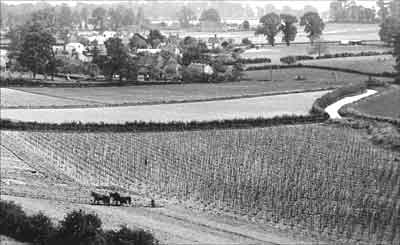
Hops were the most interesting crop grown
in Froyle. If you have not picked hops your picture of life’s rich
pattern is still incomplete. Hops are perennial and grow on vines
in hop gardens. The vines grew up coarse brown twine tied to wires
eight to ten feet up and the labourers wore stilts to tie them.
The hops are flowers that mature at the end of August and the beginning
of September. They were all picked by hand then over a period of
about three weeks. Hop picking was economically important to many
families in the village in that it was a source of income to buy
the children’s clothes and the whole family except the father would
be involved in the picking. The hops were picked either into round
five bushel baskets or into an elongated seven bushel basket, each
bushel marked as a black ring round the inside of the basket. The
ritual was that you were picked up early in the morning at various
points in an open backed lorry and taken to the hop garden where
each family was assigned a row to pick. Each family would have its
collection of things to sit on and boxes and tins to pick into whilst
mother stood at the big basket. To start with you had to hang onto
a vine to pull it down. The first ones in the morning were always
wet with enough dew to give you a soaking but the summer days that
I remember were always scorching hot so that the vines soon dried
out. When it came to picking some people could really snatch the
hops off and there was always a little inter-row rivalry in this
respect. At the same time you were expected to pick cleanly with
no bits of leaf or vine amongst your hops. Every so often during
the day the tally man would come round with a horse and wagon and
two helpers to measure the hops you had picked, tip them onto a
large piece of sacking roll them up and throw them up onto the
wagon.
The tally man would then enter the amount against your name. The
procedure was before he came to thrust your arms deep into the
hops
and fluff them up to sit as high in the basket as you could make
them. Woe betide anyone who knocked the basket after that and the
worst thing of all was to be picked up and dropped in your basket
which could turn seven bushels into three before you had time to
say “What the hell did you do that for?”
 Not all the rows had hops of the same size, some were large long and stiff whist others were small, pale and wilty. But the farmer wanted them all picked so when ever there was a move into another part of the garden where the hops were smaller the pickers would stop picking until a new price per bushel was agreed. The hard bargaining was usually done by the gypsy pickers and if you did not stop picking during the negotiations you could expect trouble not the least being to have your hops tipped out of your basket and trodden on. I honestly can’t remember the prices per bushel but figures like one and seven eighths of a penny ring in my head with those eighths being very important. You certainly had to pick a lot of hops to make a pound. When you picked hops your hands got covered by the hop resin and by lunch time your hands were black with it. Some people would pick with finger less gloves to avoid the scratching caused by the vines but it was all a pretty primitive affair with no toilet or hand washing facilities. Calls of nature had to be dealt with in the shaded areas of darkness down the end of the rows. When the time came to eat your sandwiches with resin covered hands at lunch time you soon appreciated why hops were used to make bitter beer. There were two species of wild life of interest in the hop gardens . One was what we called hop dogs a very large and voracious caterpillar feeding on the hops and the other was wasps. They seemed to adore hop gardens which seemed to have more than their fair share of nests in the ground. Whether the hop pollen intoxicated them I don’t know but they fell around stinging people too often for comfort. The hops were taken from the gardens to the hop kilns for drying and preserving and this would go on all day and all night during the short season.. It was a very pleasant experience as the chill of the evening came to wander into the warm base of the kiln where the drying fires were being maintained to dry the hops spread out on the upper floors. The men used to have glistening yellow sticks of sulphur which they used to burn to produce sulphur dioxide to help preserve the hops. When dry the hops would be raked to a hole in the floor falling into a very long circular sack where they would be compressed rock hard. to give a poke of hops. |
||
| Bill Elstow 1999 |