In the late winter and early spring from 1860 onwards, the fields around Farnham and Alton would seem to be sprouting bare poles approximately 3 inches in diameter and 15 feet tall. Around the base of the poles women were to be seen planting hop cuttings which would eventually climb the hop bines to the top of the pole and beyond. At the turn of the century a new system was adopted. The poles became 8 inches in diameter and were anchored permanently in the ground.
Men on stilts would walk between the poles and would suspend wires across the top of the poles. These carried the strings which were plugged into the ground near the plant. Up the strings climbed the hop bines. By the middle of September the hops were ready to be picked. Some 50,000 migrant workers moved into the hop districts of Kent and Hampshire. These were known as the Hop Pickers.

Every summer a letter was sent from the Rolfe family of Pevencey Cottages in New Street to Mr. Duncan, Coldrey House, Bentley applying for a basket during the Hoptime. It was essential that a party was allocated an official basket number to be assured of hops to pick and payment for the same. From then onwards, after receiving a letter telling them their basket number and the approximate date of the hoptime, the weather would be watched and the hoppers recruited and organised.
Eventually the date was confirmed and on that dale they set out for Bentley and the Coldrey hop gardens. To express it as they did, “they were going hopping and come back jumping.”
The school holidays in the Alton areas were arranged to fit in with the hoptime but not so in the Andover area, so the hopping fraternity ‘upped their chattels’ and went. When they were ready, out came spare working clothes, bundles of bedding, in some cases pots and pans and peculiarly old umbrellas to be loaded on to prams and soap boxes. Away they went, past the Mission Room, down the gullet to the Tan Yard overshadowed by the huge bark barns, round the Anton Laundry, over two river bridges to the Folly Hole where cheeky remarks were shared with Fred Hunter and his Sons Jarold and ‘Jumbo’ as they gathered the watercress, under the railway bridge bearing the Sprat and Winkle line and up the hill to the Junction station.
After a head count, third class tickets were purchased and they filed onto the down platform. Down the subway which rang to their cuckoos and whistles, and up the slope with a lot of miffing and blowing from the adults. They arrived on the up platforms, much to the amusement of the porters and the other passengers, to await the arrival of the Basingstoke train. When it arrived the elder children shepherded the younger ones into the carriages, each striving to obtain a window seat, while the adults loaded their belongings carefully in the luggage van. The first part of the journey presented the New Street hoppers with a lovely view of their own domain. On one side they could see Shepherd Springs and the culvert, while on the other side was the pot boiler, the fish river Buffers Stream, the Close Meadow and a glimpse of their Mission Room.
Over Enham Arch with a wave to Uncle Tom Rolfe and Uncle Roger Cook working for Frankie Beal the builder in the gravel pit which adjoined the railway embankment, one end of which was being filled with the towns rubbish continually being tipped by Rueben Tubb from the town’s refuse cart drawn by Herbert Smallbones’ horse. This provided a happy hunting ground for the Newstreeters in their role as ‘Toppers’.
On past Long Meadow with its lovely conker trees and Eastanton watercress beds worked by Fred Hunter. Next came Walworth and their picnic site. From then on the younger children entered a new world with their elders giving them a running commentary as they sat with noses flattened against the windows. Eventually they arrived at Basingstoke.
What a hustle. The children had to be gathered together and their belongings unloaded. Eventually all was achieved and the train departed, leaving the hoppers cluttering up the platform, much to the disgust of the porters who knew that any remarks they made would be returned threefold or, as they would say, ‘with knobs on’.
After a tremendous struggle, the party assembled outside the station there to await the arrival of Mr. Duncan to convey them to the Coldrey hop gardens near Bentley. All the hoppers’ luggage was piled onto the lorry, on top of which sat the hoppers, who, as soon as the lorry got underway, started to sing all the old songs among which was the ‘Hoppers Anthem’:
Happy happy hopping time
What a joyous service time
Gathering in the golden balls
From the posts so strong and tall
From early morn till sunset time
In the rain and in sunshine
We will be working in our rows
And singing until hopping is closed |
Twelve miles down the road they arrived, still singing, at the farm which was to be their home for the next three weeks. The sight of the hops, golden in tle sunlight, raised their spirits and they became eager to begin picking, hoping the recent wet weather had not produced too many shirt buttons, or small hops. First of all, they were allocated to various huts. Each hut contained two double bunks with a table at one end with two wide sills to sit on. Blankets were plentiful and were used to divide the sleeping quarters in the huts. These, together with pots and pans and straw for the ticks were provided by Mr. Duncan. Hot and cold water could be obtained from the drying kilns. Nearby was a hut used as a cook house. Across one end was a fireplace about five feet wide, spanned by iron bars on which pots and kettles could be suspended over the fire.
Not all the farms reached these standards. One party from New Street took a Jack Russell terrier with them and during the night a storm flooded the site. The dog’s whimpering woke the hoppers who found that their hut was flooded and that the water had reached the dog’s stomach.
A site near the huts was allocated to the gypsies whose caravans, gaily coloured outside and beautiful inside, were the pride of the women whose demeanour and decoration matched their abodes. Further away were the didicoys in their tumbledown caravans and covered carts, the men greasy and their women dishevelled. They were not very popular among the other hoppers.
Temporary first aid posts were prepared among the hop gardens, for casualties were frequent each year, But to the hop pickers, this was their holiday and some who were poorly were brought along to share the fresh air and sunshine. During one hoptide, an elderly member of the Rolfe family died. Word was sent to the Street and his relatives came with a pony cart and took him home to be buried among his own folk.
The Rolfe family went to bed early. Morning came with the sun giving the hops a golden glow to greet the hoppers eyes as, leaning on the half door, they viewed the hop gardens which varied in size from 15 to 60 acres. They were dressed in their oldest clothes as the sticky granular covering the bines stained the hands and clothes. (Washing hands was not effective so the stain had to be allowed to wear off). They made their way to the hop gardens where they collected their numbered basket which had a capacity of seven bushels, and joined the local pickers making a total of some 200. The picking started at 8am. The children with their favourite containers, mostly umbrellas, stood waiting to go. First of all the hop bines had to be pulled. This entailed tugging at the strings up which the hop bines had grown that were attached to wires which ran across the top of the 14 foot high pole, Sometimes the bine came down with a slight tug but others they had to swing on the string until suddenly it would come down with a crash and land on top of the pickers, covering their exposed flesh with scratches, their hands smarting after gripping the string,
The bines were then slung across the baskets which were placed across the 4 foot passageway between the rows of poles carrying the bines. The picking then began in earnest with the children sometimes having their own bine. After a time picking became boring until someone started a song and soon the whole garden echoed with songs old and new.
Refreshments were taken where they stood, thermos flasks or bottles of cold, unsweetened, unmilked tea. Some of the pickers would have their babies wih them who would be nestled into a heap of discarded hop bines where the sunshine and soporific smell of the hops induced slumber.
The man of the moment from then on was called the ‘pole puller’. He patrolled the gardens carrying a long pole with an iron hook on the top. Sometimes when a bine was pulled the string would break leaving a bunch of prime hops basking in the sun near the top of the pole. The call would go out for the pole puller to come and release these prime hops.
The name ‘pole puller’ descended from the time when the hops grew directly up the pole. The pole puller carried a pole to which was attached a device which enabled him to lift the pole carrying the bines out of the ground. It was then lowered across a canvas device called a surplice into which the hops were picked. He also kept his eye on the children who, in between spells of picking, played in the gardens, and he checked them when they became too boisterous. This made him lie target for abuse and chaff. If you were chastised it was no use turning to mother as she was likely to give you a whack with a hop bine for your trouble. A more popular figure among the children was the sweet man, carrying a tray of puddings 2d, bags of boiled sweets 1d.
 |
Mary Hockley with the Tallyman at Coldrey |
During the day the seven bushel basket became full and was emptied into a sack which had been distributed by the pole puller. Picking would stop at mid-day when the cry of ‘no more bines’ would ring around the garden. The pickers would craftily pull down two extra bines to keep going whilst awaiting the arrival of the tallyman. All the sacks which had been filled during the morning were dragged to the end of the row there to await the arrival of the tallyman who would shout the basket numbers of that row. Then, watched carefully by Mrs. Rolfe, the sacks containing the mornings pickings were emptied into a huge metal tub to be weighed. The weights would be called out and recorded then, and at the end of the day. They were credited to the row’s number. It was most important that the weights were correct as the payment depended on them and the weight recorded on Mrs Rolfes card. The card also enabled her to calculate how much money her party had earned that day.
The opening of the hut dour next morning was greeted with a groan as it revealed a wet, miserable outlook. Notwithstanding. the picking mustgo on. Old mackintoshes. ground sheets, overcoats and sacks made into cowls were produced and the motley procession wended their way to the gardens. Two girls from the Rolfe family returned to the huts early that day and lit a fire in the cook house, first placing a bundle of dry straw on the hearth and topping it with a faggot of wood. When the party returned, hot water and a meal awaited them, with a cup of strong. sweet tea. The evening was spent drying clothes.
In spite of the rain. the hops must be dried. The drier was the kingpin of the whole operation, which took place in the drying kiln. He had to be very experienced and a responsible person as the hops had to be of an exactly calculated dryness otherwise they would fetch a poor price. On the ground floor of the kiln a brick table contained the anthracite fire. At the edge of the table was a small pan of sulphur, the fumes of which combatted the spores of mildew in the event of the hops being stored.
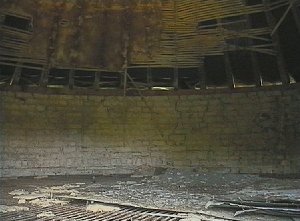 |
The kiln floor at Hodges, Lower Froyle |
The drying floor was about 20' above the fire. It was formed of open slats covered by a hair mat to prevent the hops falling through. The sacks were elevated to the drying floor level where the drier and his assistants spread the hops to a depth of l6" on the drying floor. This mass of hops would weigh about a ton. The drier and his assistants, stripped to the waist and their eyes bloodshot from the hop fumes, cast shadows on the walls like a wind blown oak.
The smell of the drying hops was unforgettable. After being expelled into the open air from the open hoods, it drifted across the hop gardens seemingly, together with the steady roar of the regulators, forming a lullaby for the countryside. When the hops were dry, they were raked into big sacks known as pockets about 5’ long, each having the grower’s name and numbers marked upon them. The hops were compressed into the pockets until each was as tight as a drum. The neck was sewn up and the pocket rolled to one side to await transport.
The next day being Saturday, the Rolfe family were expecting visitors. Back in Andover the boys of the family, after finishing their work at 12 noon and eating their midday meal. mounted their cycles and rode the 30 miles to Bentley bringing with them all the Street’s local news and gossip.
When the hop picking finished that day. the Rolfe party returned to their hut and a family reunion. After a meal and awash and brush up, they adjourned to the cook house which had been made cosy by the addition of a bucket of red hot coals scrounged from the drying kiln and seating provided by surplus hop poles. A sing song developed with songs old and new accompanied by mouth organs, The singing New Street style was melodious if not always tuneful. ‘They carried on merrily until the day’s work and the smell of the drying hops induced them to return to their huts and sleep.
Saturday night for many was pub night although some pubs did not welcome them as their signs indicated. This applied particularly to the didicoys as their behaviour when intoxicated was unpredictable. Didicoys were not strangers to The New Streeters, as several families camped at the bottom of the Street and used its public houses, albeit cautiously. They were often referred to as ‘my dear cousins’ this being a common figure of speech among them. They had their own slang and some of the Street’s children who made contact with their children became fluent with it. This consequently gave rise to some awkward situations when they heard some things they were not supposed to understand.
After the pubs closed the hoppers could be heard rolling home sometimes by the light of the silvery moon which, shining on the rows of hop bines, made them look very mysterious.
Sunday was a day of rest for some. For the children it was a day for games with a rope for skipping or slung over the branch of a tree for a swing, while a plank and an oil drum made a see-saw. Among the men a gambling school developed with brag, pontoon and poker. and those who only had pennies, pitch and toss, with no need to look out for the Coppers. For the women there was a meal to be prepared and a gossip over elevenses.
After Sunday dinner the Salvation Army officer arrived and after the washing up the hoppers gathered around to join the singing of the gospel hymns. No hymn books were needed. The officer accompanied the singing with his melodeon and told them the Old Old Story. After the service and a tea, the Rolfe boys set out for home with messages for those who wore left behind.
A short distance down the road there was another group of hopgardens belonging to Mr. Messenger. The pickers came from Basingstoke, Southampton, New Street and Bentley. One of the pole pullers was a well known Andover character nicknamed ‘Happy Joe’. The men from The Pelican Inn in the Street hired a bus from Hiscocks of Little London, to convey a party to Bentley for hop Sunday which they spent among their families.
The boys from the different areas were keen footballers and they formed teams and played matches between each other, providing entertainment for those interested and healthy exercise for themselves. Many a lad started the football season a better player after his session in the hop gardens.
As the days passed, so the individual gardens were cleared and a move had to he made to another garden. Sometimes this meant using the public highway, thus causing a traffic problem. To obviate this, signs beating the inscription ‘Caution Hop Pickers’ were placed at each end of the column. This caused strangers to the district to be a little apprehensive but they were amazed and amused at the sight of some 200 dirty men, women and children dressed in tatty old clothes, carrying sundry containers such as baths, baskets, bundles of clothing, umbrellas and old prams complete with babies and here and there a branch of hops which was waved at the passers by. They sang their way along until they disappeared into a hop garden, there to he allocated their row of bins bearing the golden hops ripe for plucking. Some parties had to make two or three journeys to transfer all their belongings, leaving their fast pickers to get started on their row.
So the days went by until some three weeks after arrival The New Street hoppers started on their last row. Their thoughts were of home some 30 miles away. The children had mixed feelings, longing to see their school friends but feeling they would miss the comradeship of the hop gardens. Eventually they came to the end of their row and the call echoing ‘no more poles’ for the hoppers brought the hoptide to a close.
When the New Street pickers pulled down their last bine they saved the top bunch of hops which they would take home to New Street. There it would become part of the Harvest Festival in St. Mary’s Mission Room. On their return to the huts they picked up their belongings ready for the return journey, finishing the day with a grand singsong in the cook house.
In the morning Mrs. Rolfe sorted out the accounts which told her how much she should receive when she went to the office at Mr. Duncan’s Coldrey House, Eventually she did so, to the satisfaction of all concerned. On her way there she met the gypsies who had been on the same errand. When she returned to the huts she met their caravans. They were on their way to the Kent hop gardens near Ashford which commenced picking a fortnight behind Bentley as they specialised in brown hops as compared with Hampshire’s green variety. Later the didicoys with their ponies and traps passed by on their way to Bentley and the public houses. They set up a pony sale. showing off their ponies, running them up and down the Bentley Road. The ponies and traps made quite a spectacle as they were raced along by their drivers, encouraged by the whip.
Came the afternoon and the lorry to take the New Streeters to Basingstoke station and the first stage of their journey home. As it happened, it was a slow train and the children were fascinated by the small stations, hearing the porters calling out the stations’ names and the guard’s whistle as he signalled that the train was ready to move, and watching the smoke flying past the windows following the chuff, chuff, chuff as the engine pulled away until they looked down on the watercress beds from Hurstbourne Viaduct and heard their elders say “the next one’s ours”. Sure enough, their own territory came into view as they crossed over Charlton Road railway bridge and heard the porter shout ‘Andover Junction through the subway for Tidworth, Marlborough and Swindon.”
Happy to be retracing their footsteps made three weeks ago, they came into the Street. The school children were coming down the road and the cry rang out “The hoppers are back”, Front doors flew open and friends and neighbours welcomed them home. The evening was spent settling in, the copper was lit and the children were bathed in front of the fire, and so to hed
This might be the end of the story but no, the children went to town with their mothers the next day and some of the money they had worked to earn paid for their winter clothing. As it happened, this was the day before the St. Mary’s Mission Room harvest festival when the Newstreeters took their offerings to the Mission Room. The hoppers children took their bunches of prime hops. Some of the ladies viewed the hops with misgiving until they noticed the children of some of the very poor families, their brown faces and sparkling eyes, new clothes and shoes bought with money they had helped to earn picking these very hops. The ladies accepted the hops and humbly placed them with the other offerings thinking truly, “God moves in a mysterious way His wonders to perform”.
The hoppers did forget their trip to the hop gardens as it was weeks before the stains wore off their hands and the smell wore off their clothes. But all in all, they were happy and rewarding memories.
Today, hop picking as a social occasion is no more. Schools no longer recognise hop picking holidays. The hopgardens have become mechanized. The pickers required are few in comparison. No more will the children be happy to ‘Go hopping and come back jumping.’
Harry Paris |
