
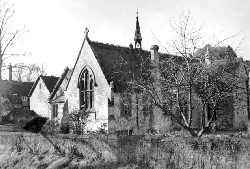
 In this extract from her “History of Froyle School”,
the late Nora Jupe, the last headmistress, records the effect
of the
Second World War on life at Froyle School. The photograph shows the
School in 1947. In this extract from her “History of Froyle School”,
the late Nora Jupe, the last headmistress, records the effect
of the
Second World War on life at Froyle School. The photograph shows the
School in 1947. “The Summer holiday of 1939 was divided into two parts; the first (for corn harvest). was from August 4th - 14th and on the children’s return to school they were told to take their gas masks with them for adjustment and practice (These masks had been supplied by local wardens a few weeks earlier as another war now seemed inevitable). Two parents refused to let their children take their masks and four masks were faulty or the wrong size so this was reported to their own Air Raid Wardens who had been training in wartime procedures for some months. The gas masks were supplied in strong cardboard boxes with a string shoulder strap (some children used ready-made bags and cases instead, mostly made from rexine, a ‘leather-look’ cloth.) During the course of the war, the masks had to be taken everywhere with their owner and children were sent home to collect theirs if forgotten. Thankfully they never needed to be put into actual use but after the use of poisonous gas by the Germans in the First War, there was a great fear (especially in the first year of the war) that gas might be a lethal weapon again. Gas masks were manufactured from light sheets of rubber (strong but flexible); they had a pig-like filter or snout and a clear oval eye-screen; they were fitted to the head shape by adjustable straps. Gas mask practice became as regular an event as fire practice, although there is only one recorded practice at the school in July 1943. As school closed again on August 25th (for the hop harvest) there is no mention of the outbreak of war in the Log (September 3rd was a Sunday and was in the school holidays so the children did not need to be sent home as they were already on holiday.) By the time school reassembled on October 2nd things had settled down again. Froyle was not a ‘danger area’ from sea or air attacks and no record is made of evacuees at the school, so it was presumably not a reception area either. Also, as there were no staff changes due to conscription etc., school proceeded fairly normally apart from having buckets of sand and stirrup pumps on view and possibly sticky brown paper strips on some windows (to prevent the glass shattering from blast.) Arrangements must have been made for taking shelter in an air raid and traces of wooden battens on the Junior classroom window, plus old blackout curtains discovered years later in the ‘cubbyhole’, suggest that at least one room could be blacked out and used after dark (provided of course not a chink of light showed through!) Weather conditions were quite severe the first winter of the war and, after the fortnight’s Christmas holiday, an epidemic of measles broke out and lasted the whole of the Spring Term. Things improved with warmer weather after Easter but as the fear of invasion grew, the Whitsun holiday was restricted to three days and the Summer holiday to two weeks. As most children still worked in the hopfields in the late summer, ‘registers’ were ‘not to be marked until mid-September’ and even then only 31 out of 73 pupils on the books were present! September passed and with it the Battle of Britain (no doubt by this time the pupils were becoming skilled at recognising aircraft, both ‘theirs’ and ‘ours’, particularly if they were out working in the hopflelds and they must have collected and swapped pictures or cigarette cards of the planes.) The first mention of enemy action in the Log Book was on October lst, when the closing of registers was delayed as many children were late owing to ‘Air Raid during the night’.  Winter school hours were changed, the start and finish being delayed half an hour from 9.00 to 9.30 a.m. and 3.30 - 4.00 p.m. (probably due to the clocks not being changed from Summer-time that Autumn.) In the very wet Spring of 1941 the timetable was often re-arranged to fit in gardening on fine days. In April that year the boys were taken over to the Park (the grounds opposite the school) to gather sheep’s wool from the fences and hedges. Flocks of sheep were increased to help with the food shortage (much lamb having come from New Zealand in refrigerated ships pre-war), also the girls were encouraged to knit gloves and balaclava helmets for the troops and blanket squares for hospitals. There was a shortage of stock supplies for schools, particularly paper; pupils’ exercise books were inspected regularly to make sure no space was wasted. New textbooks were scarce, and wartime books were printed on poor paper to a special wartime standard. Encouraged by the ‘Make Do and Mend’ Campaign to save new materials, in needlework lessons the girls learnt how to turn old garments into new, smaller ones and. later in the war, parachute silk was also used. In the autumn of 1941 boys were allowed to go for a day’s potato picking and 9 boys took advantage of a day off school (plus some payment for the task, which must have been back- breaking at first.) Women now filled many jobs as men were in the armed forces or doing essential work. This meant women caretakers in school, Mrs.Lucas took over her husband’s duties in November 1940, but in Decernber 1941 (when her child had whooping cough) the teachers were left to clean out and light the stoves, also sweep and dust the classrooms. The ‘Milk in Schools’ scheme commenced in 1941 and Froyle school children were supplied with a third of a pint of (free) milk from Mr.Andrew from the neighbouring farm, Blundens. In April 1942 the Easter holiday was for three weeks, to include a potato planting holiday. Empire Day was now a very important celebration with patriotic messages read and suitable songs sung. Sometimes visitors came to speak to the children and gave prizes for essays after their talks. The local policeman (P.C.May, stationed in Bentley) took Road Safety sessions during the war, also lessons on various ‘dangers’ (wartime and otherwise presumably). Termly exams were still given to the children and classes were re-arranged at the beginning of the Summer Term each year. In April 1944 the ‘School Meals Service’ was introduced - meals were cooked on the premises (in the original Headteacher’s room) and each day during the first month, 44 dinners were served. Many of the mothers of the children were now at work so the tradition of ‘going home to dinner’ changed and the children were supervised by the teachers, the cook and kitchen helper. Attendances were low in the snowy winter in January 1945 when only 18 children out of a possible 59 attended school, the Log Book recorded ‘Many of the children have no suitable boots, the parents have the money but no (clothing) coupons. Also suitable boots are in short supply in the shops.’ (Wellington boots were not made during the war as the rubber materials were scarce and required for military purposes.) Victory came at last and the entries in the Log for May 8th and 9th 1945 were made in red ink (Red Letter Days!) There was no school on the two V.E. (Victory in Europe) Days. All over the country, parties were arranged, in schools or in streets with fancy dress and flags flying. Two days school holiday were also given for V.J.Day (Victory over Japan) on 15th and 16th August, as the school had not broken up like most schools in the country because of the late hop-harvest. One other day’s holiday at that same time was on July 5th as a polling station for the General Election was in the school buildings.” |