For 136 years the Methodist Chapel
in Froyle has been open for worship. On the occasion of its closure
we look back on the growth of
Methodism in this small Hampshire community.
Methodism had actually come to the village twenty years before the Chapel was built, during a Primitive Methodist Mission to Alton and district organised by the Micheldever Circuit. For a few months in 1841 there were regular meetings somewhere in Upper Froyle, comprising a Sunday Service at 1.30pm and a Weekday Meeting each Tuesday. Nothing else is known of the work there and the meeting very quickly died out. Very likely they never obtained the regular use of a house for indoor meetings. After the closure of the mission a Travelling Preacher was stationed at Holybourne and no doubt also sought to spread the gospel to the adjoining villages. It seems he must have had some response, certainly at Lower Froyle, for in 1846 it was decided to move the struggling Holybourne meeting to Froyle. There they met at the house of George and Harriet Reed. This was one of the dwellings into which the old workhouse had been divided. The building still survives - almost opposite the village hall. There were then twelve members of the Society, including a number who came from Holybourne. They also had the benefit of a resident Minister, or Travelling Preacher, as they were then called. This was John Wright, and he must be the only Methodist Minister ever to have been stationed at Froyle. However, the remoteness of the village from the centre of the circuit, Micheldever, created difficulties. The Travelling Preacher was moved to Basing, the numbers dwindled, and it seems in about 1849 the congregation changed their allegiance and joined the Bible Christian branch of the Methodist Church. George Reed, who had been a Local Preacher under the former body, continued to be recognised as such after the transfer, and his house was registered for worship. But the change did not have the desired effect and after a few years the Society became extinct, probably because of the existence of a more flourishing Bible Christian Society at East Green, Bentley, and the building of a chapel there in 1854. And so along came the Wesleyan Methodists to build on the missionary work of the Primitives and Bible Christians. At the March, 1860, Local Preachers’ Meeting of the Guildford Circuit - Alton became a separate circuit later in the same year - it was decided that Froyle should come on the plan. Where exactly they met is not known - perhaps it was again the old workhouse. In 1861 there were Sunday Services at 10.30am and 6pm, with the Lord’s Supper once a quarter, and also a Wednesday Evening meeting twice a month. Things moved quickly. In that same year a site was purchased from William Messenger and a start made on erecting the present Chapel. The Trustees appointed at that time were John Benjafield (farmer), Albert Hiscock (farmer), John Chubb (blacksmith), John Goddard (shepherd) and Uriah Benjafield (believed to be a wheelwright from Holybourne) and six from other churches in the circuit. William Hall, a shoemaker from Upper Froyle, was one of the witnesses of the conveyance. The Chapel was built of stone with brick quoins at a cost of £260 and a date, 1861, can be seen crudely inscribed on a stone in the north west wall of the building. It was officially opened in 1862 and had, until now, the honour of being the oldest Methodist Chapel still in use for worship in this area. Little is known of the next thirty years but among the couples whose children were baptised at the chapel were:- John & Eliza Benjafield, Emanuel & Caroline Trim, George & Jane Shute, David & Harriet Bowman, Charles & Jemima North, George & Jane Mills, Caleb & Eliza North, Charles & Jane Covey, James & Susan Cole, George & Mary Stimson, and George & Rosa Cox. In those early years the Chapel Anniversary was always held on Easter Monday. The report of the occasion of 1892 is typical. The Alton Mission Brass Band was there and two van loads of visitors came from Alton. Tea was served, followed by a meeting. The following year there was also an Open Air Service before the evening service. 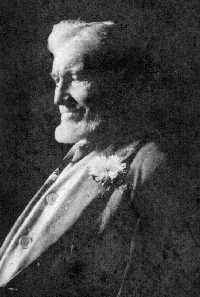 By 1890 the name of ‘Hockley’ was prominent in chapel affairs. Charles
Hockley (right) used to belong to Bentley Parish Church. As a boy he had the
job of filling the oil lamps there, for which he got twopence a week. It is said
that with his first sixpence he bought himself a bible. Certainly he became a
shining light for Christ. At Froyle he served in every possible way - Poor Steward,
Chapel Steward, Society Steward, Sunday School Superintendent, Class Leader,
Trustee and Local Preacher. There are records of him speaking at Chapel Anniversaries
as early as 1892. By 1890 the name of ‘Hockley’ was prominent in chapel affairs. Charles
Hockley (right) used to belong to Bentley Parish Church. As a boy he had the
job of filling the oil lamps there, for which he got twopence a week. It is said
that with his first sixpence he bought himself a bible. Certainly he became a
shining light for Christ. At Froyle he served in every possible way - Poor Steward,
Chapel Steward, Society Steward, Sunday School Superintendent, Class Leader,
Trustee and Local Preacher. There are records of him speaking at Chapel Anniversaries
as early as 1892.In 1903 the Society Stewards were Charles Hockley and his father in law, Edward Hall. Mr. Hall, who had succeeded to his father’s shoemaker’s business in Upper Froyle, had been a leader at Froyle for many years prior to that date. Hockley’s brother, James, was also a regular preacher. A memorial to the brothers is in the form of the Chapel’s unusual font which bears the words ’Presented to Froyle Chapel, July, 1929, in loving memory of Charles and James Hockley who served so faithfully in the Methodist School and Circuit for over 50 years.’ The earliest membership figures are for 1900 with 15 in September and 17 in December. From then until 1905 the numbers fluctuated between 13 and 17. A decline then set in with a minimum of 7 being reached two years later. Subsequently a recovery took place and, from 1910 onwards, the membership was always in double figures. 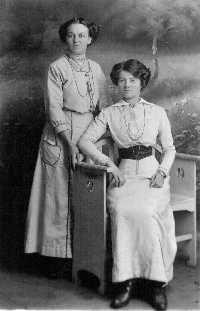 For many years there was a strong Sunday School. In 1910, for example, there
were 32 scholars and 4 teachers. They met both morning and afternoon. Certainly
at a later date, and probably at this time also, the 3pm appointment shown on
the plan was the Sunday School. Then the normal practice was that a preacher
would be appointed to take the afternoon Sunday School and then, after staying
for tea, the evening service at 6pm. This most probably accounts for the rather
incongruous entry in the Minute Book of 1938 - “The secretary was instructed
to write and thank Miss Hall and Miss Mills, the organists, and also to express
their thanks to them for entertaining the preachers on Sundays!” For many years there was a strong Sunday School. In 1910, for example, there
were 32 scholars and 4 teachers. They met both morning and afternoon. Certainly
at a later date, and probably at this time also, the 3pm appointment shown on
the plan was the Sunday School. Then the normal practice was that a preacher
would be appointed to take the afternoon Sunday School and then, after staying
for tea, the evening service at 6pm. This most probably accounts for the rather
incongruous entry in the Minute Book of 1938 - “The secretary was instructed
to write and thank Miss Hall and Miss Mills, the organists, and also to express
their thanks to them for entertaining the preachers on Sundays!”These two ladies, pictured right, Miss Emily Mills and Miss Louise Hall, who was Edward Hall’s grand-daughter, were two stalwarts of the Chapel. As well as being organists for over 30 years, they were joint Sunday School Superintendents for many years. At one time there were said to have been as many as eighty belonging to the Sunday School. They also took over as Society Stewards after the death of Charles Hockley in about 1929 and continued as such until 1971. Others who should be mentioned include Miss Mills’ brother, Charles, who from 1937 until 1958, when he had to retire owing to ill health, was both Treasurer and Secretary to the Trustees of the Chapel, and Walter and Mavis Start, who took up the two offices on Mr.Mills retirement and have continued serving Froyle Methodist Chapel to this day. The years 1952 and 1953 were particularly significant for the Froyle Chapel. For some years the lack of any accommodation other than the chapel had been strongly felt. In 1952 this difficulty was overcome by the erection of a wooden hut next to the chapel on a site which had once been part of Charles Hockley’s garden. No doubt he would have been pleased to see it so used. The hut has an interesting story. After the sale of Union Road Primitive Methodist Chapel in Farnham in 1936 a site was bought in an area in which it was expected the town would develop with the intention of ultimately erecting a church there. In the meantime a tennis court and pavilion - the hut - were put on the site. However, the development at Farnham did not take place and so the site was sold in 1952 and the hut sold to the Froyle Chapel for £100. As well as serving as a pavilion, it had also been used for a time at Farnham for other meetings. |
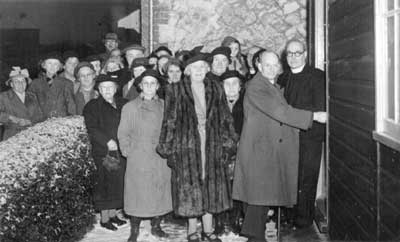 |
‘Charlie’ Mills opening the new schoolroom on November 26th 1952 |
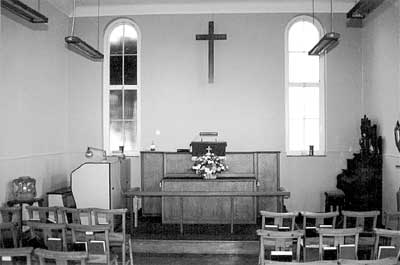
Following the erection of the Schoolroom it was immediately decided to renovate
the Chapel and so on 25th September 1953 a completely renovated Chapel was reopened
by Mrs. Thomas. According to the newspaper report it had formerly been a drab
building, dark and uninviting with a bare wooden floor and only hard benches
for the congregation. Externally the chapel had been changed little, apart from
the roughcast applied to the front and south east walls and the removal of the
porch. The roughcast covered up an engraved stone high up on the front of the
building. There were formerly two flights of steps from the road - one to each
side of the porch. The presence of the porch had made it very difficult to manoeuvre
coffins into the Chapel for funerals and so such services had often been held
at the house of the deceased. |
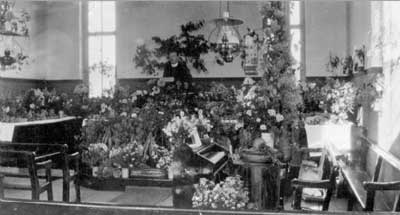 |
A Harvest Festival in the 1920s - note the benches for the choir |
Internally
the changes were greater. Previously there had been a centre
aisle, no fixed screen inside the door, three or four fixed pews
at the back, and forms
in front which were moved for the Sunday School. There were also choir pews
at either side of the pulpit - there was a flourishing choir
in Froyle for many
years, at least up until about 1960. There was a solid fuel stove to provide
the heating and the building was open to the rafters. The pulpit had two
fine oil lamps with spherical glass shades on the wall behind
it. The changes involved
new strip lighting, rubberised floor, new pulpit, chairs of light unstained
wood, and the erection of a ceiling. Membership reached a peak of 23 in 1958, but then a gradual decline set in; 19 in 1961, 11 in 1971 and 11 again in 1981. The numbers had not increased even though members of Crondall Methodist Church had joined Froyle in 1979, following the closure of their own church. Perhaps the writing was already on the wall for Froyle’s building. The Chapel was rewired in 1990 and in 1991 work was carried out on the roof, the entrance and the schoolroom. Further roof repairs were carried out in 1995, but with falling numbers - only 8 by now - and mounting costs, it was obvious that the Chapel could not be kept open. The Minutes of a meeting of the Chapel Council held on Thursday, 27th November, 1997, tell the sad story - “The Quinquennial Report had been received from the surveyor & the cost of repairs prohibitive & beyond the financial means of the Chapel. After discussion it was unanimously agreed that the Chapel be closed... All the members expressed a wish that the Chapel should close with a Thanksgiving Service in the Spring.” The numbers that will be attending that service are a testament to Froyle Methodist Chapel’s important place in the community. |
Taken from notes by David Woodcock M.A. with additional material from Froyle Methodist Chapel Council Minute Books and the Froyle Archive. |
For some pictures of the events at the Chapel click More