 |
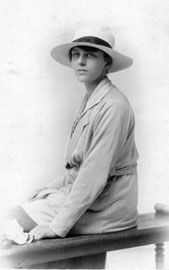
| Lilian Smither (right) writing in the Hampshire Magazine about her childhood at Sylvesters Farm, Lower Froyle. |
  I
was born at Sylvesters Farm House, Lower Froyle, on May 7th, 1900, the
third child of the late Mr & Mrs George Herrett
Westbrook. My father rented this farm for 40 years, from 1894 to 1934.
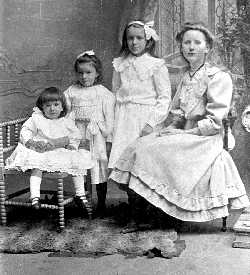
We were a family of four daughters; this photograph (left) of us was taken in 1909. Our only brother, William George, died of pneumonia
at the age of 7½ years, a real tragedy in the family. I
was born at Sylvesters Farm House, Lower Froyle, on May 7th, 1900, the
third child of the late Mr & Mrs George Herrett
Westbrook. My father rented this farm for 40 years, from 1894 to 1934.
We were a family of four daughters; this photograph (left) of us was taken in 1909. Our only brother, William George, died of pneumonia
at the age of 7½ years, a real tragedy in the family.
 The farm house was built in 1674, and this date can be clearly seen at the back of the house, obviously on the older part. The building on the left facing the front door was, no doubt of a later date. This front door was very heavy with an enormous key and if my memory serves me correctly, a large bolt at the bottom and top. The illustration shows the door standing open and the little “picture”, which appears to be in the centre of the door, is a window at the far end of the passage, looking out into the orchard. This passage was approximately 40 ft long, from the front to the back of the house. Immediately inside this front door were three or four large flag stones, the remainder of the passage being red brick, with here and there a coconut mat. 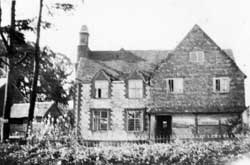 The first room on the right of the passage was the pantry, a large room
with a small window high up under the ceiling. Inside one looked to
the right to see a barrel of beer. Father never visited a public house
as he didn't abide, as he put it, the smell and smoke, but he enjoyed
a glass of beer at dinner time. I often filled his glass and on one
occasion I tasted the stuff. How awful, how could Father, or anyone
else for that matter, drink it? I was then about 12 years old. Next
stood the churn for butter making each week. 12 or maybe 20 lbs, according
to the amount of cream available. Lovely butter - sold at 1s 2d a lb!
In the winter it was kept in the Dairy, in the summer carried to the
cellar on slabs of slate. A large meat safe came next and two long shelves
opposite, always full of good home made food. The first room on the right of the passage was the pantry, a large room
with a small window high up under the ceiling. Inside one looked to
the right to see a barrel of beer. Father never visited a public house
as he didn't abide, as he put it, the smell and smoke, but he enjoyed
a glass of beer at dinner time. I often filled his glass and on one
occasion I tasted the stuff. How awful, how could Father, or anyone
else for that matter, drink it? I was then about 12 years old. Next
stood the churn for butter making each week. 12 or maybe 20 lbs, according
to the amount of cream available. Lovely butter - sold at 1s 2d a lb!
In the winter it was kept in the Dairy, in the summer carried to the
cellar on slabs of slate. A large meat safe came next and two long shelves
opposite, always full of good home made food.
Through the Pantry was the Dairy, a newer building than the house. A tiled floor, white walls and in 1910, on May 7, Father bought a milk separator. This mysterious machine was quite something in those days. Father was not too pleased with it, he having to turn the handle. I was up early that morning, my 10th birthday. The Postman arrived with the news that King Edward VII had died, also bringing me a card without a ½d stamp. My Mother, in the excitement of the moment, and getting the postman 2d for the surcharge on the card, was late with the jug of hot water which had to put into the separator before the supply of milk ran out. Father called, I ran for Mother to bring the hot water, (which was not allowed to go into the milk or cream) and we met at the heavy curtains near the pantry door. I screamed as the hot water went over my face and neck. Father hearing my scream, guessed what had happened suddenly let go the handle of the separator, instead of releasing it gradually and broke a small part. In his concern for me with a scalded face and neck, he threatened to throw the new machine into the farm pond. Poor Mother, poor me, I sat in the kitchen, Mother dabbing my face with snow water, which she had saved from the previous winter. No scar was left on my face but my neck suffered quite badly. Next on the right from the passage was the dining room. A very pleasant room, a long window occupying nearly the whole length of one side and looking out over the farm yard. Large shutters hung down below the window but these were never used in our day. Nicely furnished with an oak refectory table, large dining table and antique dining chairs. In the winter a large green heavy plush curtain was hung from the black beamed ceiling, touching the floor and about two thirds across the room to stop the draught from the front door which faced north east. The floor was red brick, covered with lino, later with a good carpet. A hanging oil lamp decorated the room, which gave both light and heat. A window high up on the inside wall, looked into the passage, a borrowed light. The fire place stood about 18 inches front the hearth, no doubt the original having been bricked up. Opposite this room, across the passage, was the drawing room, a good grate burning both wood and coal. A wide mantelpiece, full of ornaments, with a pretty material frill hanging from it. There were three windows, two with seats and when the winter curtains were up, one could sit in the window behind the curtains and not be seen. The whole house was a marvellous place for playing hide and seek. An oval walnut table with a centre splayed pedestal support, red patterned sofa, armchairs and six small chairs to match and of course, a piano, complete with candlesticks. All four daughters bad lessons, a teacher coming to the house from Isington. A picturesque oil lamp stood on a small oak table. Continuing along the passage we come to the cellar door, 10 steps down, passing a small wine cupboard on the right; two rooms here, parted with a started screen of wood. Bottles and other debris lived here and a large drum of paraffin oil to supply the large and small lamps used around the house. We carried candles to go to bed. Now the front stairs, well carpeted, bannisters painted two shades of green. No doubt they should not have been painted at all. We must return to the main passage, turn left along a short passage and a blocked up window, with small lamps standing on the window sill, and into the little room, where extra china was stored and a Rag Bag. Everyone in those days had a Rag Bag! Here we kept our bicycles when we were considered old enough to possess such means of transports. Back to the passage and now we reach the side door into the garden, with its massive bolt and chain. Here is the little “picture” window, turn right and there was the back stairs. No carpet here. We enter the large kitchen here, a very strong door with a very wide iron bolt. What a kitchen; no bedroom over, and walls continued tip to the roof. A good kitchen range; high above your head was a bacon loft, which needed a ladder for entry. I never reached such heights, nor did my sisters as far as I know. A brick bread oven, the fireplace at floor level which Mother never used. The room was L shaped although we never thought of it in that way. A huge copper; what activity on wash days! The water in the copper had to boil to keep the white clothes white. The hired washerwoman was a pleasant, kindly soul. Mother being short had to stand on a stool to use the copper stick to push the clothes under the boiling water. Bavins were used to light and keep the fire burning. This wood stretched across the floor, brick of course, and whoever thought of it, just pushed them into the fire. The sink had to be seen to be believed, red brick, with a slatted draining board, and it was not uncommon to see a large slug come up from the open drain outside! The room boasted three windows, two towards the orchard and one by the sink. The strong back door was low and wide with enormous bolts, no lock. Two pigs were killed each year, one pork, one bacon. The local pig killer was called and after the kill the animal was hung up for two days and then brought into the kitchen, laid on a long wooden bench and the animal cut into joints and carried to the cellar by Father and salted as necessary. Every part of the pig was used in some way; pork pies were delicious, liver and crow and brawn. The only part of a pig which cannot be used is the SQUEAK! I well remember standing at the kitchen door watching these gruesome proceedings, but I enjoyed the good wholesome food. We return to the front stairs and main bedroom, which we girls occupied in turn, two at a time as we grew older. A small part of one window opened, this had an iron bar from top to bottom; no fear of burglars here! The room was stocked with useful furniture; all beds, pillows, bolsters and cushions were filled with feathers plucked by Mother from numerous chickens, ducks and turkeys. A large cupboard and a small one in the wall, showed how thick these walls are. Back along the passage, turn left, a window here looking over garden and orchard and then a small bedroom and a similar wall cupboard. From the short passage at the top of the front stairs, turn right, through a door way but no door, on to the back landing, a large dark cupboard, no window. I never went inside, only looked, to see a cot, cradle and wicker clothes basket. It was known as the dirty linen cupboard. A small oak barrel used by my Mother's family farm in Braishfield for taking beer and cider to the hay and harvest fields hung on the wall, also a copper warming pan. Each have now found a more prominent position. A large oak chest stood on this landing. It would have been completely dark but for an opening in the wall, draped with lace curtains tied in the middle - no glass. The back stairs ended here on this landing, with Mother and Father's bedroom door exactly opposite, A large room, window overlooking the farm yard, thatched stables and barn and a tiled cowpen, well-carpeted and adequately furnished also with two cupboards. Through this room was the nursery, although we never termed it thus. It was the small children's room, with two windows high up, so as children we could not look out. This room faced the road. We all washed in the same water, hot or cold, according to the season. 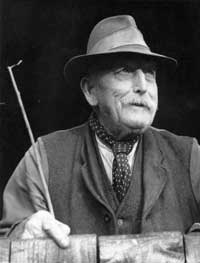 Returning
to the back landing, a very substantial door lead to three attic rooms,
one with a ceiling. Here the cowman slept, a good friend and farm worker
to the Westbrook family (Jack Day - picture left). I was 12 years
old when he first entered our home and worked on the farm in all kinds
of jobs, although he was officially the cowman. He stayed with the family
until his death at the age of 86, a period of over 50 years. The other
two attic rooms had no ceilings. One was entered by a very narrow board,
approximately 4 ft x 1½ ft which had to be lifted out for entry.
I well remember looking in, but I never ventured to see what was beyond.
I wish now that I had. The other room, if the wind was in a certain
direction, let snow through the tiles and Father was not too pleased
when he had to take a bath and buckets and sweep up the snow to prevent
it coming through the ceiling of the main front bedroom. Returning
to the back landing, a very substantial door lead to three attic rooms,
one with a ceiling. Here the cowman slept, a good friend and farm worker
to the Westbrook family (Jack Day - picture left). I was 12 years
old when he first entered our home and worked on the farm in all kinds
of jobs, although he was officially the cowman. He stayed with the family
until his death at the age of 86, a period of over 50 years. The other
two attic rooms had no ceilings. One was entered by a very narrow board,
approximately 4 ft x 1½ ft which had to be lifted out for entry.
I well remember looking in, but I never ventured to see what was beyond.
I wish now that I had. The other room, if the wind was in a certain
direction, let snow through the tiles and Father was not too pleased
when he had to take a bath and buckets and sweep up the snow to prevent
it coming through the ceiling of the main front bedroom.
Of course there was no electricity, gas or running water. Father had to draw all water from the Well at the rear of the house and we bathed in a zinc wash tub with our knees up under our chins when grown up. The toilet in the garden, a double seater, was very convenient with a family of four girls, when one or other had to make the trip into the garden after dark. We all enjoyed and loved that old house. Two daughters married and left, two still live in the village and are affectionately known as “Grace and Ena. ” |