
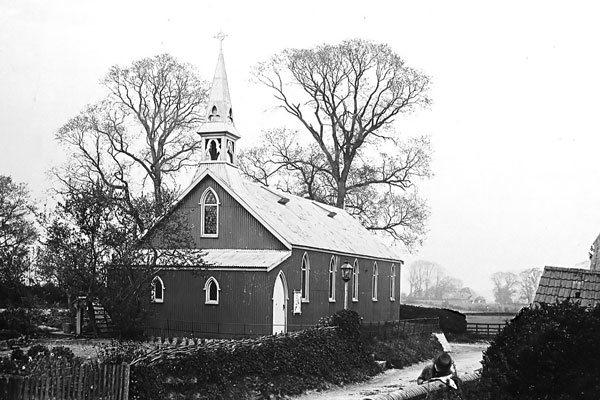
Having read Sir Hubert Miller’s personal scrapbook, we now know that St. Joseph’s Church in Lower Froyle was actually built in 1879/80 on this small plot of land opposite the “Prince of Wales” Public House. The “Mission Church of St Joseph” was dedicated at a special service on Thursday, March 18th, 1880 – you can read a report from the Hants & Berks Gazette of March 27th by following the link below.
Sir Hubert had been concerned that all should be encouraged to attend church and the idea was to save the villagers of Lower Froyle the walk of a mile or two to St. Mary’s in Upper Froyle. It was supposed to be a temporary church until a permanent one could be built on other land in the village. However the Great War of 1914 delayed this and the land allocated for the permanent church was requisitioned to build council houses, so Lower Froyle never did get its new church.
The building was finally demolished in 1967, and the site is now part of the garden of the appropriately named “Church Cottage”.
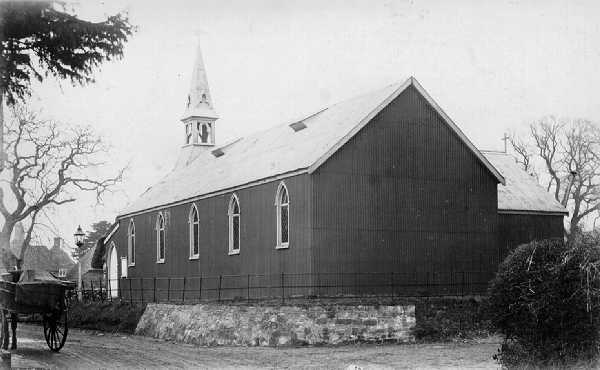
During the month of August, parishioners would have to travel to Upper Froyle to worship, as St. Joseph’s would be closed. Being almost entirely constructed of corrugated iron – and, originally, painted red – it became unbearable in hot weather. Another problem with its construction was that, when it rained on the corrugated roof, no-one could hear themselves think, let alone hear what the minister was saying. During the autumn the children would sit and stifle giggles as berries from the trees which overhung the church dropped and bounced down the roof.
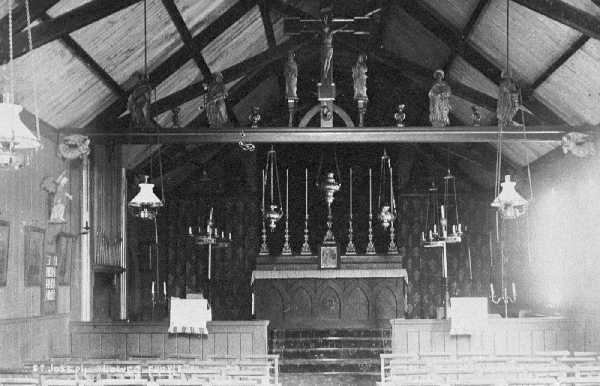
The late Mrs. Lilian Smither, whose family, the Westbrooks, are mentioned in the Parish Records as far back as 1653, remembered the church well: “Just inside the porch stood a mahogany stool given by my grandmother, Mrs. Louisa Westbrook, who died in January 1900. Inside, the stations of the cross were all around the walls and the congregation sat on chairs, not pews”.
Statues, for which Froyle is famous, abounded. The organ had to be pumped by hand, a job more often undertaken by the younger members of the village. Now all that is left of Froyle’s “Tin Tabernacle”, as it used to be affectionately called, is just a name on a cottage, some old photographs and a few fading memories.
Then and now
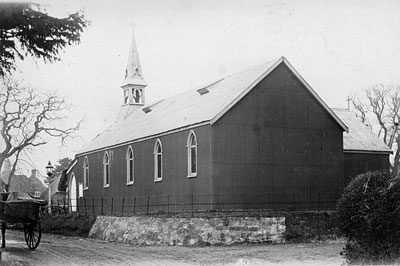
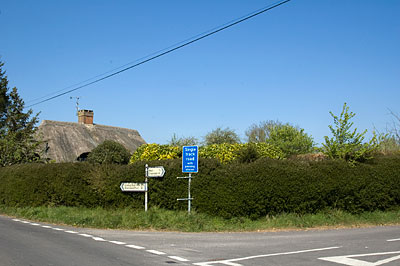
The left hand picture was taken at the turn of the last century – the modern picture was taken in 2001. There is one major difference – St. Joseph’s was demolished in 1967. “The Prince of Wales” is also no longer a pub – it became a private house in 1998. Apart from the missing church, the following changes have taken place:- The road has been surfaced and white lines painted. The large trees have been cut down. The church site is now part of the garden of the appropriately named “Church Cottage”. Telephone lines now cross the area.