
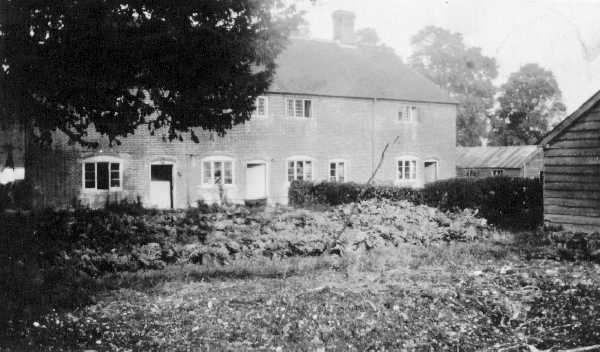
I’ve called it by its modern name, but “Brecklands” was the old Workhouse in Lower Froyle. It was built somewhen before 1793 as a workhouse and converted into cottages around 1835. This picture was taken in 1938 when the building was still several cottages. Nowadays they have all been joined into one large house, although you can still see where some of the old doors were.
“There was a Poor House, Froyle, (Workhouse Cottages), in 1806, and now called Brecklands. Meetings of the Overseers were held alternately at the Hen & Chicken and Anchor, and occasionally at the Poor House. The Poor House was converted to cottages in about 1835. Several meetings were held at the Checkers, (or Chequers), at Well.” (Tom Knight 1933)
“A substantial red brick Poor House was built in Lower Froyle in 1806. It was converted to cottages in 1835 when Froyle, with 20 other parishes, came into the Alton Union. Until recently they were known as Workhouse Cottages, but the name has been changed to Brecklands. When a Poor House the Overseers of the Poor met here in turn with the Hen & Chicken and the Anchor.” (Froyle W.I.Scrapbook 1952)
However, according to “Hampshire Treasures Survey”, published by Hampshire County Council in 1982, things are slightly different:- “Brecklands, Lower Froyle. Two storeys. Red brick with brick cornice. Hipped tiled roof. Casement windows. Originally a Workhouse until Alton Workhouse was built in 1793.”
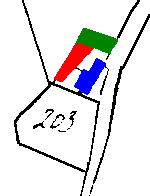
This would date it before 1793 – more research is needed. We are certain it was there in 1814 as the first edition of the Ordnance Survey, dated August 14th 1814 shows the Workhouse complex. The Tithe map of 1847 (the picture on the right is a small extract from it) shows clearly that Workhouse Cottages was a much bigger place than it is now with the present ‘Brecklands’ (coloured green) being the North Wing of a much larger building. The blue coloured block could well have been the “Workhouse Cottages” mentioned below. Certainly by 1871 the accomodation had been greatly reduced in size.The Census tells the story:-
| 1841 | 1851 | 1861 | 1871 | 1881 | 1891 | |
| 1 | William Frost | William Gilham | William Beckhurst | George Neal | Henry Baker | |
| 2 | John White | William Bunce | John Neale | James Neal | James Neale | James Neal |
| 3 | Charles Neal | James Rampton | Richard Lunn | John Neal | John Neal | Harriet Neal |
| 4 | Moses Marlow | Jane Willis | Jane Willis | |||
| 5 | Richard Lunn | Fanny Rampton | Frances Rampton | |||
| 6 | George Reed | James Baker | ||||
| 7 | William Port | William Bowers | ||||
| 8 | Richard Lunn | Uninhabited |
In the 1861 Census the first three (Beckhurst, Neal& Lunn) were recorded as living in the Old Workhouse, while the others (Willis, Rampton & Baker) were living in Workhouse Cottages. One of these was uninhabited. From then on they were shown living in Workhouse Lane. By 1871 there are only three families remaining in Workhouse Lane – from this it would seem that the original Workhouse complex was reduced in size, probably by the demolition of those parts of it attached to the main building.The modern-day Brecklands is now a single private house.
Then and now
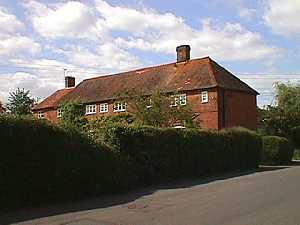
The 1998 picture is taken from the road, but shows the same side of Brecklands – in the 1938 picture, the road is between the end of the building and the Tennis hut in the middle right distance.