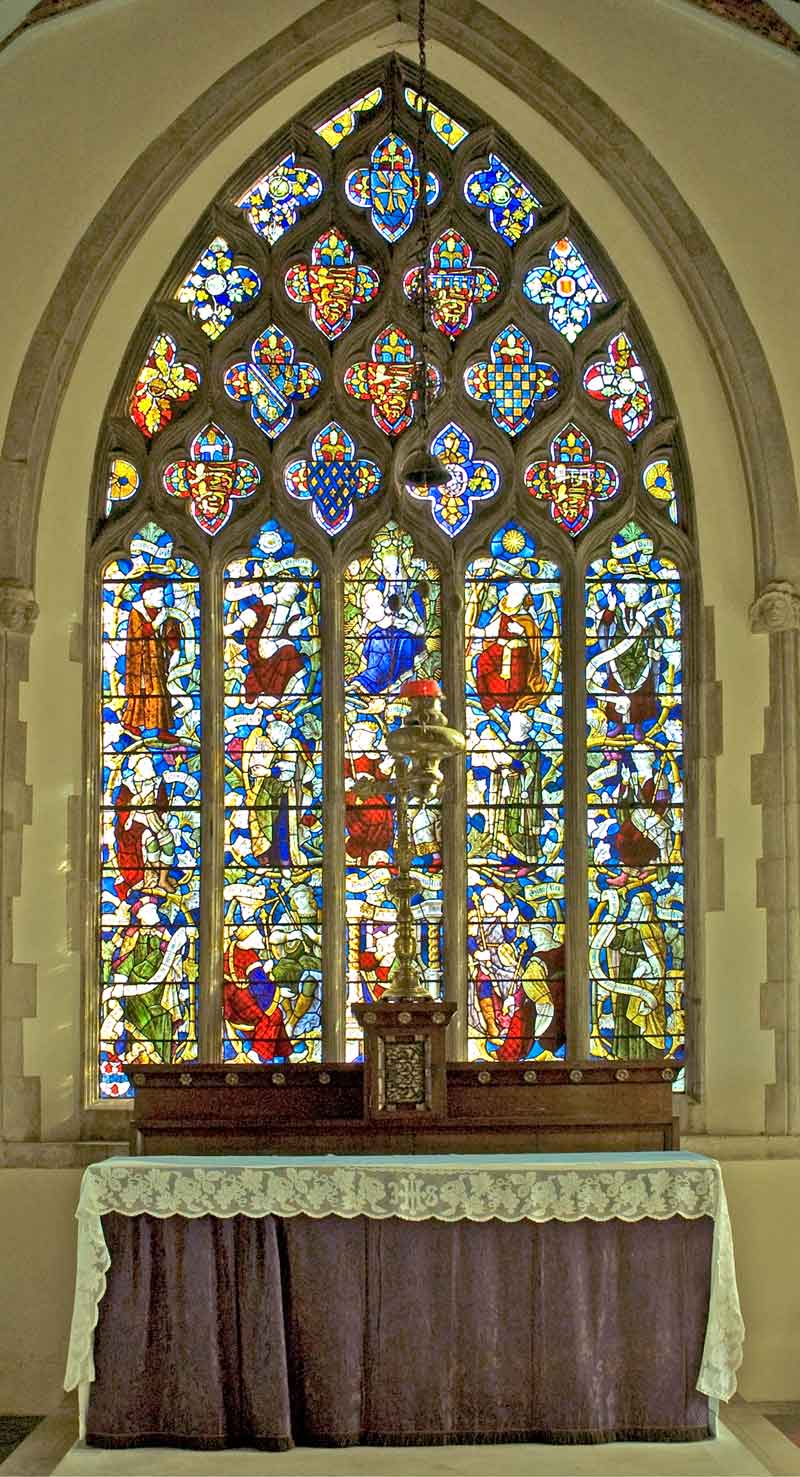
Although the church may not be so rich in heraldry as others in which famous people are remembered, there is still much of local historical interest; and the armorial glass in the East window is probably without peer in any other small English church. Furthermore, tombs and hatchments together record the deaths of the Lords of the Manor over 200 years, from 1666 to 1868.
This description covers five aspects of the church’s heraldry
- The East Window.
- Other Heraldic Glass.
- The Tombs.
- The Funeral Hatchments.
- The Royal Arms.
Throughout this account a family name followed by a description in brackets gives the blazon of the relevant arms.
I should like to pay tribute to the work of Mr. Tom Knight who, in the 1930s, did much research into the history of Froyle, and whose notes have been of great assistance to me.
The East Window
The upper portion of the east window contains mainly armorial glass, and is thought to be contemporary with the building of the church. It is immediately apparent that all except one of the coats of arms represent members of the Royal family in the 14th Century, or families loosely connected with the Throne. The present arrangement of the glass (which has been altered at least twice in the past 150 years) is as follows, (see photograph and Appendix B):-
| Top row | Azure a cross patonce between four martlets or. These are the arms designed by the 13th Century heralds for Edward the Confessor; he himself would never have borne them, as heraldic arms did not come into general use until the first half of the 12th Century. As St. Edward was one of the patrons of England it is not unusual to find these arms in Ecclesiastical buildings. |
| Second row | Gules three lions passant guardant in pale or. These arms are known as ‘England’ and were used without change on their own by the Kings of England from 1198 to 1340. They are still found in the present Royal Arms. ‘England’ with a label of five pieces azure. These arms were used by both Edward II and Edward III before their accession to the Throne. |
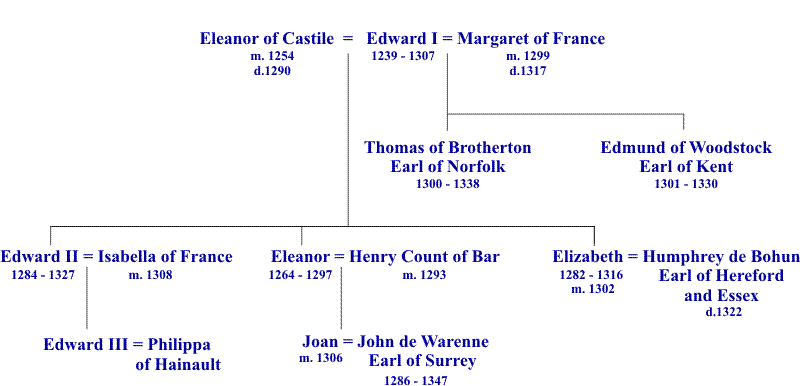
| Third row | Azure a bend argent cotised between six lions rampant or. These are the arms of de Bohun. Humphrey de Bohun, Earl of Hereford and Essex married Elizabeth, daughter of Edward I, in 1302; she was a widow at this time, having previously been married to John, Count of Holland & Zealand. Humphrey de Bonun was slain at Boroughbridge (1322) in arms against his king, as it means that the window must have been made before 1322. ‘England’. Checky or and azure. The arms of Warenne, Earls of Surrey.Checky or and azure. John de Warenne married Joan of Bar, a grand-daughter of Edward I in 1306. |
| Fourth row | ‘England’. Azure semy of fleurs de lys or. These arms are known as “France ancient”;Azure semy of fleurs de lys or. and were borne by the French kings until about 1365. They were also borne by Margaret of France, second wife of Edward I, and by Isabella of France who married Edward II in 1308. Sable a lion passant crowned argent between six cross crosslets or. This coat is believed to be that of the family of Chastelon Sable a lion passant crowned argent between six cross crosslets or. and is the ‘odd man out’ in the window. The glass is not contemporary with the other glass; the Chastelon family had no connection with other people recorded in the window, nor do they appear to have had any local association. ‘England’ with a label of five pieces argent. These arms were borne by Thomas Brotherton, Earl of Norfolk, and son of Edward I by his second wife, Margaret of France. |
Having identified the persons or families commemorated by the arms which have survived, one needs to try to find the reasons for their association and why they appear in the window at all. As will be seen from the notes at Appendix B the common factor is clearly descent from, or connection by marriage with, Edward I. All nine of the original shields, except that of the Confessor, can be so accounted for, and a guess hazarded as to the identity of the tenth, (the lost shield replaced by Chastelon).
In each of the panels the colour of the background is either blue or red, counter changing with the colour of the field of the arms borne thereon. Of the original nine shields five have red fields (England, the heir apparent, and Brotherton) on blue backgrounds, and four have blue fields (St. Edward, France, de Bohun, Warenne) on red backgrounds. Therefore, to conform with the probability of counter changing of colours throughout the window, it is likely that the original missing shield had a blue field (on a red background). Might this have been the arms of France repeated, for Queen Margaret the second wife of Edward I, who died in 1317?
This is indeed possible, for the Lordship of Alton Hundred was in the King’s hands, and descended with the manor of Alton Westbrook; at least from the time of Edward I who granted it first to his mother, Queen Eleanor, and then, in 1299, to Queen Margaret. Following her death in 1317, Edward II gave it to his half brother Edmund of Woodstock in 1319; Edmund was executed in 1330.
If indeed the missing shield were for Queen Margaret the window was probably made before 1317. At the same time, the use of silver stain to produce the yellow of some of the glass indicates a date after 1307. Furthermore, although it is likely that there was a previous church on the site, records suggest that the first incumbent of the present church was Walter de Berton in 1307.
If the above argument is accepted, then it is probable that the glass was placed in the church at same date between 1307 and 1317.
Another suggestion has been made that the missing shield might have been that of Edmund of Woodstock, to whom Edward II gave the Lordship of Alton Hundred in 1319. The argument against this is that his arms (England with a border argent) are borne on a red field which would break the strict counter changing of colours as explained above. If this were the solution, then one could date the window somewhat later, between 1307 and 1322, when de Bohun was killed at Borroughbridge in arms against his king.
The importance of the missing shield is considerable, but it does seem certain that the window commemorates the Lords of the Hundred of Alton with some of their relations living, and it may well have been a royal gift to the newly built church.
Finally, how were the shields originally arranged? Charles Winston, who visted the church on 18th December 1848, (see note below), refers to the glass as having been altered by Aubertin (see note below), but one is at least able to reconstruct a possible original
| Edward the Confessor | ||
| Edward II | Queen Isabella | |
| Prince Edward | Queen Margaret | Brotherton |
Warren
or de Bohun
Joan
or Elizabeth
de Bohun
or Warenne
Elizabeth
or Joan
Notes
- These notes could not have been prepared without the great help given by Mr. John A. Goodall F.S.A.
- Charles Winston pioneered the serious study of stained glass in England and his notebooks in the British Museum include quite a long account of the glass at Froyle (Add-M.S.33847 p.209 ff). A later reference (p250) deals unsatisfactorily with the arms and the relationship of the persons commemorated.
- The Reverend Peter Aubertin and his wife were amateur glass painters living at Chipstead, Surrey; and, according to the Parish records, he was curate at Froyle from 1842 to 1862 under the Reverend Sir Thomas Miller.
- Reference is made to the window in the Victoria County History of Hampshire but some statements are not to be relied upon.
The East Window – Relationships
Other Heraldic Glass
Nave – Window in North Wall
A roundel with the arms of the Kings of England as borne between 1405 and 1603. The origin of this glass is not known.
Chancel – Window in North Wall
A roundel bearing the Miller ((Said to have been granted by Dugdale, Garter King of Arms in 1684.) Argent a fess wavy azure between three wolves’ heads proper, the badge of Ulster.) arms in the window to the memory of William Uvedale Miller who died 1868.
East Window
The glass representing the “Tree of Jesse”, given by Sir Charles John Hubert Miller in 1898, has the Miller arms in the bottom left hand corner.
Sanctuary – Window in South Wall
This window is in memory of Sir Thomas Combe Miller and of his wife Martha; their arms are in the top of the window. They are similar to those in the hatchment over the north door.
Heraldry of the Tombs
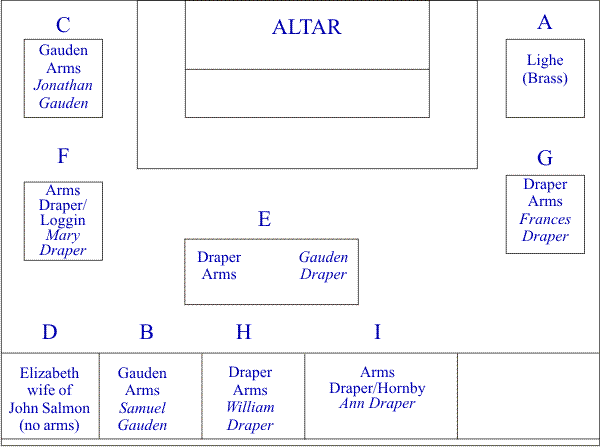
In the following notes the tombs are dealt with chronologically
A. The LIGHE Brass
This memorial is to John Lighe (or Leigh) who owned, and lived at, Coldrey, and died in 1515. It would appear that originally there was a brass of his wife facing him.
Only the first two quarters of the arms can be identified with any certainty, the first being LIGHEGules cross engrailed and a border also engrailed argent. and the second LEIGH. Azure a plate between three ducal crowns or a border argent. As the spelling of the name was interchangeable these are likely to be branches of the same family.
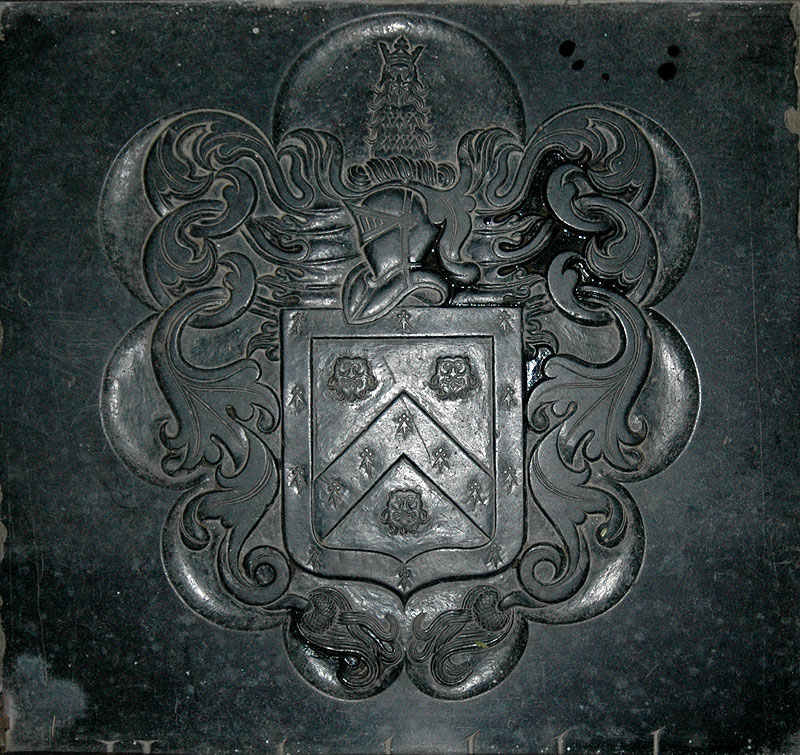
B. GAUDEN Azure a chevron ermine between three lions faces or a border
Samuel Gauden died 1st September 1693 in his 59th year. He had bought the Manor of Froyle from John and Robert Fiennes in 1666. He was succeeded as Lord of the Manor by his son Jonathan.
C. GAUDEN Azure a chevron ermine between three lions faces or a border
Jonathan Gauden, who succeeded his father as Lord of the Manor in 1693, died on 5th May 1705 in his 58th year. He was succeeded by his nephew Gauden Draper.
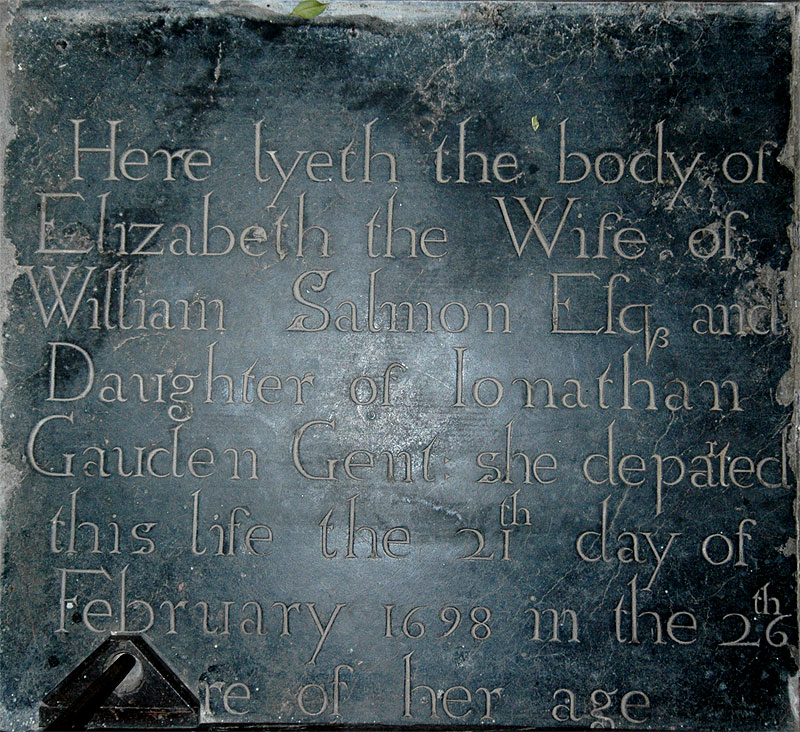
D. No Arms
Elizabeth, wife of William Salmon, was a daughter of Jonathan Gauden and she died 21st February 1698 in her 26th year. She had married William Salmon 31st July 1694.
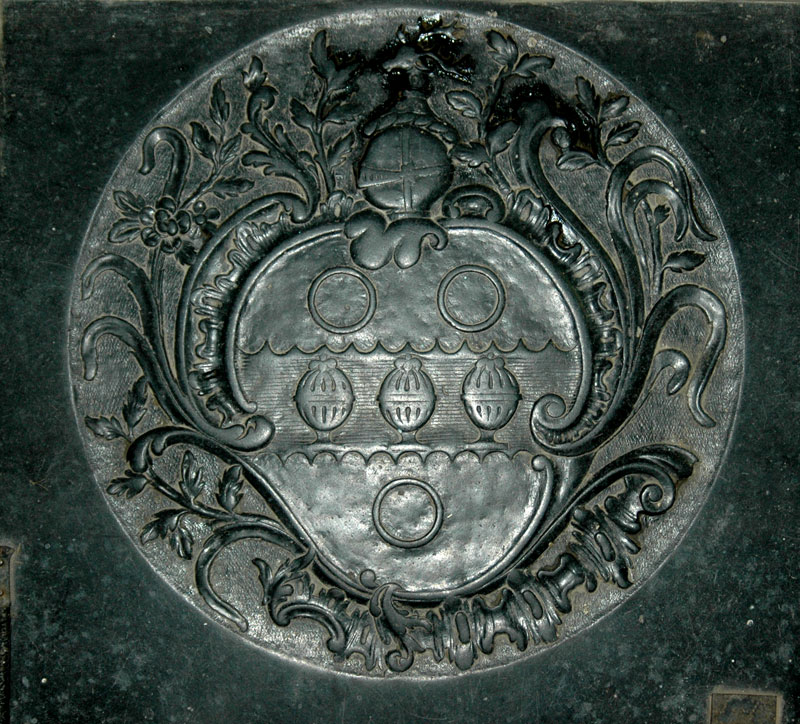
E. DRAPER Argent on a fess between three annulets gules three covered
Gauden Draper succeeded his uncle Jonathan Gauden as Lord of the Manor in 1705 and died 14th August 1710 in his Ord year. He married Mary Loggin who died in 1727. He was succeeded by his son William Draper.
F. DRAPER Argent on a fess between three annulets gules three covered impaling LOGGIN (Or a lion passant in chief three piles sable)
Ann Mary Draper, wife of Gauden Draper (E), died 3rd April 1727 in her 64th year. It is probable that she was related to Frances Loggin whose tomb is in the centre aisle of the Nave. (See below).
G. DRAPER Argent on a fess between three annulets gules three covered in a lozenge
Frances Draper, daughter of Gauden and Mary Draper, died 29th March 1721 in her 19th year. Her arms are displayed on a lozenge as she was an unmarried woman.
H. DRAPER Argent on a fess between three annulets gules three covered
William Draper, who had succeeded his father as Lord of the Manor in 1710, died 28th August 1765 aged 67. He married Ann (Hornby) who died in 1732.
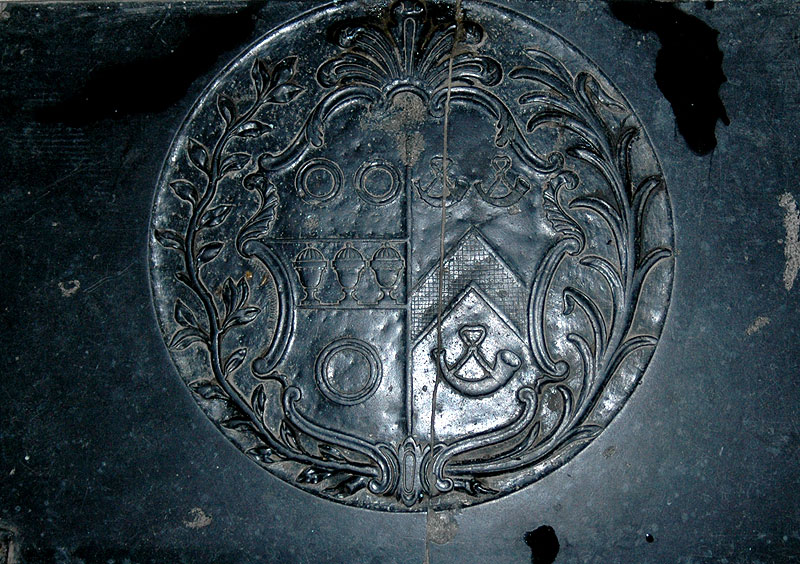
I. DRAPER Argent on a fess between three annulets gules three covered impaling HORNBY Argent a chevron between three bugle horns sable stringed gules.
Ann Draper, wife of William Draper, died 17th February 1732, also William Draper, their only son, aged 3 years.
Tombs and Memorials in the Nave
NICHOLAS (Argent a fess wavy between three ravens sable. Argent on a cross gules an imperial crown or. Argent on a chevron between three ravens sable two lions passant respectant argent. (Nicholas of Winterbourne Earls) Argent on a fess between three ravens sable three lions rampant argent.)(Memorials only, no arms displayed)
William Draper was succeeded as Lord of the Manor by his daughter Mary, who married William Nicholas of Basingstoke on 15th September 1748. William Nicholas died 13th June 1764. Mary Nicholas died in 1791.
William and Mary Nicholas had twin sons, John Nicholas and William Draper Nicholas, who died in 1778 and 1786 respectively – there is a memorial to them on the south wall of the Nave. Between 1765 and 1782 the Nicholas family disposed of the Manor piecemeal to Sir Thomas Miller, fifth baronet.
LOGGIN (Or a lion passant in chief three piles sable) (In central aisle)
Frances Loggin, daughter of William Loggin of Butlers Marston, Warwickshire, died 28th November 1724. It is possible that Mary, wife of Gauden Draper, was related. It should be noted that the daughter of Gauden and Mary Draper bore the Christian name of Frances, and that the Vicar of Froyle in 1755 was Thomas Loggin
MOODY (Vert a fess engrailed argent surmounted of another gules between three harpies argent. (On the hatchment the harpies are incorrectly shown as owls).)
Although there are no Moody tombs within the church a memorial tablet on the north wall of the Nave commemorates:-
Mary Anabella Moody, daughter of William & Mary Nicholas and widow of Richard Vernon Moody, died 2nd December 1829 aged 73. Mary Klizabeth Moody, died 29th July 1855 aged 67, and Rebecca Anabella Moody, died 2nd April 1860 aged 69, both daughters of Mary and Richard Moody.
The Funeral Hatchments
Introduction
It was at one time the custom, when an armigerous person died, to paint his or her armorial bearings on a diamond shaped panel of canvas or wood, and to place this on the house-front as a sign of mourning. These paintings were called hatchments and, after the funeral and period of mourning, they were removed to the parish church.
St. Mary’s is rich in such hatchments, which will be seen hanging on the north, east and south walls of the nave. In the following descriptions the names only of the persons to whom the arms refer are mentioned; blazoning of the coats may be found by hovering over the name in black.
Description of the Hatchments
Above the North Door
Miller(Said to have been granted by Dugdale, Garter King of Arms in 1684.)
Argent a fess wavy azure between three wolves’ heads proper,the badge of Ulster. impaling in chief Gilbert of NorfolkGules two bars ermine in chief three fleurs de lys or. and in base Holmes of NorfolkBarry of eight or and azure a border nebuly ermine on a canton or a chaplet.. This records the death in 1864 of the reverend Sir Thomas Combe MILLER, 6th Baronet, his wife Martha (nee HOLMES) surviving him. She was the eldest daughter of the Reverend John Holmes of Bungay, Suffolk; Sir Thomas had married her on 5th May 1824; she died on 28th June 1877. Sir Thomas Combe Miller was Lord of the Manor from 1816 till 1864; he was also Vicar of Froyle from 1811.
On the North Wall
The arms of PEPPERELLArgent a chevron gules between three fir cones vert on a canton gules a fleur de lys argent, a badge of Ulster.. presumably bearing, in the centre, on an “escutcheon of pretence”, the arms of his wife Elizabeth, daughter of the Hon. Isaac RoyallAzure three garbs or.. This records the death of Sir William Pepperell, Bt., of London, who was buried at Froyle on 27th December 1816. His only son, William Royall, died at West Cowes on 29th September 1798, aged 23, and was buried at Froyle on 6th October 1798. With these deaths the baronetcy became extinct.
Notes:
The following extract from Burke’s Extinct Baronetcies is of interest:-
“William Sparhawk Esq. son of Nathaniel Sparhawk of New England, Merchant, by Elizabeth Pepperell only daughter and heir of Lt. Gen. Sir William Pepperell, Bart., having become heir to his grandfather at the decease of that distinguished officer in 1759, assumed the surname of Pepperell and was created a baronet 9th November 1774. He married on 12th November 1767, Elizabeth, daughter of the Hon. Isaac Royall of His Majesty’s Council in Massachusetts Bay and had issue – William Royall b. 5th July 1775 d. 27th September 1798. Two daughters. Sir William died 18th December 1816 when the Baronetcy expired.”
There would appear to be no specific authority for the arms shown as being borne by Royall (azure, three garbs or). For more details of the Peperreill family and Froyle’s American Connection, follow this link.
Above the Pulpit
| Quarterly | 1st & 4th | MILLER(Said to have been granted by Dugdale, Garter King of Arms in 1684.) Argent a fess wavy azure between three wolves’ heads proper,the badge of Ulster. |
| 2nd | COMBERArgent a fess dancetty gules between three estoiles sable. | |
| 3rd | EDWARDSPer bend sinister ermine and ermines a lion rampant or. | |
| Impaling | SCOTTPer pale indented sable and argent a saltire counter changed. |
This records the death (12th January 1868) of Sir Charles Hayes MILLER, 7th Baronet, his wife Katherine Maria (nee SCOTT) surviving him. She was the 2nd daughter of James Winter SCOTT of Rotherfield Park, Hampshire; he married her on 9th April 1856. Sir Charles Hayes Miller was Lord of the Manor from 1864 till 1868 when he was succeeded by his son Sir C. J. Hubert Miller.
Above the Side Altar
| Quarterly of sixteen on a lozenge | |
| 1st & 16th | MOODYVert a fess engrailed argent surmounted of another gules between three harpies argent. (On the hatchment the harpies are incorrectly shown as owls). |
| 2nd | CLIVEDON or CHENDONOr a lion rampant sable crowned argent. – not surely identified |
| 3rd | LEE or LEAPer chevron or and gules two lions combattant sable. |
| 4th | Possibly CHUTEGales three swords fesswise in pale argent pommelled and hilted or that in the centre pointing sinister, the other two pointing dexter an orle of mullets all within a border engrailed argent. – not surely identified. |
| 5th | NEWBURY? Sable three pallets ermine on a canton azure a lion rampant argent. |
| 6th & 7th | NICHOLAS Argent a fess wavy between three ravens sable. Argent on a cross gules an imperial crown or. |
| 8th | NICHOLAS OF WINTERBOURNE EARLS Argent on a fess between three ravens sable three lions rampant argent. |
| 9th | NICHOLAS Argent on a chevron between three ravens sable two lions passant respectant argent. |
| 10th | Whitewell? Gales a chevron between three buckets or. |
| 11th | Roches? Azure three fishes fesswise in pale argent. |
| 12th | Not identified Or three bulls heads cabossed in fess sable. |
| 13th | Not identified Azure on a fess or three cross crosslets sable. |
| 14th | DRAPER Argent on a fess between three annulets gules three covered |
| 15th | Hornby Argent a chevron between three bugle horns sable stringed gules. |
At the top of this hatchment, there is a bow of blue ribbon frequently used to indicate an unmarried woman. This hatchment probably records the death of one of the unmarried daughters of Richard Vernon Moody and his wife Mary Anabella (daughter of William and Mary Nicholas). These two unmarried daughters were Mary Elizabeth (died 1855) and Rebecca Anabella (died 1860). There is an identical hatchment in disrepair in the gallery, which, it is assumed, refers to the death of the other daughter.
On the South Wall
| On a lozenge | MOODYVert a fess engrailed argent surmounted of another gules between three harpies argent. (On the hatchment the harpies are incorrectly shown as owls). |
| On an escutcheon of pretence – quarterly | |
| 1st | NICHOLASArgent on a cross gules an imperial crown or. |
| 2nd | NICHOLAS OF WINTERBOURNE EARLS Argent on a fess between three ravens sable three lions rampant argent. |
| 3rd | DRAPER Argent on a fess between three annulets gules three covered |
| 4th | Hornby Argent a chevron between three bugle horns sable stringed gules. |
This doubtless records the death of Mary Anabella Moody, widow of Richard Vernon Moody and daughter of William and Mary Nicholas. The hatchment shows the arms of her husband (Moody) and, on an escutcheon of pretence, the arms of her father’s and mother’s families to which she was heiress. It should be noted that, as the hatchment refers to a widow, it is on a lozenge but, as she was a married woman, there is no knot of ribbon at the top.
On the South Wall near the Gallery
| Quarterly 1st & 4th | MILLER(Said to have been granted by Dugdale, Garter King of Arms in 1684.) Argent a fess wavy azure between three wolves’ heads proper,the badge of Ulster. |
| 2nd & 3rd | COMBERArgent a fess dancetty gules between three estoiles sable. |
| An escutcheon of pretence | EDWARDSPer bend sinister ermine and ermines a lion rampant or. |
This records the death of Sir Thomas Miller, 5th Baronet and Member of Parliament for Portsmouth, who died 4th September 1816, his second wife Elizabeth (Edwards), an heiress, surviving him. He was succeeded by his son, the Reverend Sir Thomas Combe Miller.
The East Window: photograph