
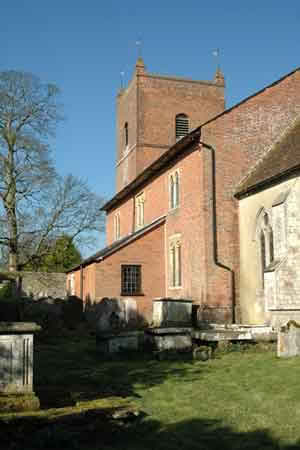
The south side of St Mary’s Church in Upper Froyle on a sunny March morning in 2005. In the centre of the picture, tucked up agains the church wall, is a large family tomb.
With the light in the right direction and a bit of squinting, the following inscription can be made out: In memory of ISAAC ROYALL Esqr, late of Medford in New England, who departed this life October 16th 1781 aged 62. Also in memory of MARY McINTOSH ERVING, daughter of the above ISAAC ROYALL and wife of GEORGE ERVING Esqr, late of Boston in New England and now of this parish. She departed this life November 11th 1786 aged 42.
The question arises as to how Isaac Royall and his daughter came to be buried in a quiet English churchyard thousands of miles away from their home?
But there is more to this mystery inside the church. High on the North wall is the hatchment of Sir William Pepperell who died in London in December 1816. A quick examination of the church records reveals no Pepperell, but there is a Pepperall, and the full entry reads, “Pepperall, Sir William. Buried 27th December 1816. Of London, aged 70.” There is another entry as well, “Pepperall, William Royal. Buried 6th October 1798. The only son of Sir William bart aged 23 years. Died at West Cowes.”
From past experience we have found that there are many differences in the recording of names over the years and so this person is obviously our Sir William, and it explains why his hatchment hangs in the church.
But the story doesn’t end here!
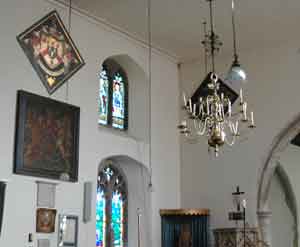
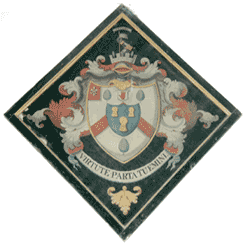
The hatchment (shown right in full and left in its position on the wall) is, basically, a diamond-shaped escutcheon bearing the deceased person’s arms.
First of all we investigated the Pepperell connection. This search took us a long way from Froyle and back in time over two hundred years to before the American Declaration of Independence. The first Sir William Pepperrell was born in 1696 at Kittery Point, Maine (then part of Massachusetts). A wealthy merchant, landowner, and businessman, he became a colonel in the colonial militia, was a delegate to the Massachusetts General Court and a member of the governor’s council, and was appointed chief justice in 1730. In 1745 he commanded the land forces that, with a British fleet under Sir Peter Warren, captured the French fortress of Louisburg, on Cape Breton, Canada and became known as ‘The Hero of Louisburg’. In recognition of this service, he was the first Native American to be created baronet in 1746 and briefly governed Massachusetts between 1756 and 1757. He died in 1759.
The first Sir William had been what is called a “self-made man”, and had raised himself from the ranks of the soldiery through native genius backed by strength of will. The mansion now seen in Kittery Point, Maine, was built partly by him, and partly by his more eminent son. The building was once much more extensive than it now appears, having been some years ago shortened at either end. The lawn in front reached to the sea, and an avenue a quarter of a mile in length, bordered by fine old trees, led to the neighbouring house of Colonel Sparhawk, east of the village church. The first Sir William, by his will, made the son of his daughter Elizabeth and of Colonel Sparhawk, his residuary legatee, requiring him at the same time to relinquish the name of Sparhawk for that of Pepperell. Thus it was that the baronetcy, extinct with the death of the hero of Louisburg, was revived by the king, in 1774, for the benefit of this grandson.
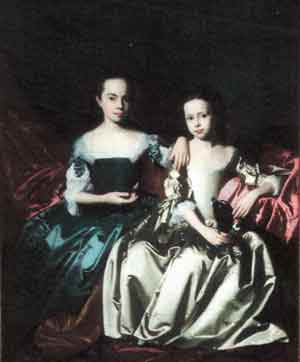
Photograph by Lady Palmer of original picture
in Museum of Fine Arts, Boston
‘Our’ Froyle Pepperrell was this son, William, who graduated from Cambridge (Massachusetts) in 1766 and the next year married Elizabeth Royall. This is where the link to the Royall family appears.
These were tempestuous years as the colonies in America struggled to break free of British rule – a struggle that divided the people into those who wanted liberty from the king and the loyalists who supported the status quo.
In 1774 he was chosen as a member of the governor’s council, but when this council was reorganised under the act of Parliament, he fell into disgrace because of his loyalty to the king. On November 16th 1774, the people of his own county passed a resolution in which he was declared to have “forfeited the confidence and friendship of all true friends of American liberty, and ought to be detested by all good men.”
Thus denounced, the baronet retired to Boston, and, in 1775, sailed for England. His beautiful lady, one is saddened to learn, died of smallpox ere the vessel had been many days out, and was buried at Halifax.
However, in “The Elegant Royalls of Colonial New England”, her obituary in the Boston News Letter of October 19th 1775 states that “Last Sunday morning (October 14th), after a few days illness, departed this life in the 28th year of her age, the Lady of the Honourable Sir William Pepperrell, Baronet……. Her remains were very respectfully interred last Thursday evening”. The statement in the previous paragraph from “The Romance of Old New England Rooftrees” stating that she died at sea is, obviously, incorrect.
In England, Sir William was allowed £500 per annum by the British government, and was treated with much deference. He was the good friend of all refugees from America, and entertained hospitably at his pleasant home. His private life was irreproachable, and he died in Portman Square, London, in December, 1816, at the age of seventy. His vast possessions and landed estate in Maine were confiscated, except for the widow’s dower enjoyed by Lady Mary and her daughter, Mrs. Sparhawk.
On July 4th 1776 Congress adopted the Declaration of Independence and everything changed.
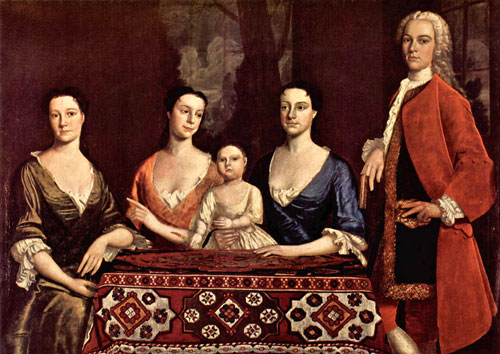
His father-in-law, Isaac Royall (pictured left with his family in 1741), though he acted not unlike his son-in-law, Sir William, has, because of his vacillation, far less of our respect than the younger man in the matter of his refusal to cast in his lot with that of the Revolution. In 1778 he was publicly proscribed and formally banished from Massachusetts. He thereupon took up his abode in Kensington, Middlesex, and from this place, in 1789, he begged earnestly to be allowed to return ‘home’ to Medford, declaring he was “ever a good friend of the Province”, and expressing the wish to marry again in his own country, “where, having already had one good wife, he was in hopes to get another, and in some degree repair his loss.” His prayer was, however, refused, and he died of smallpox in England in October 1781. By his will, Harvard College was given a tract of land in Worcester County, for the foundation of a professorship, which still bears his name. But, what is the connection between these two famous names from American history and Froyle?
Text extracts from The Romance of Old New England Rooftrees by Mary Caroline Crawford Eighth Impression, March, 1908
Original painting is the property of Harvard Law School, Cambridge MA US
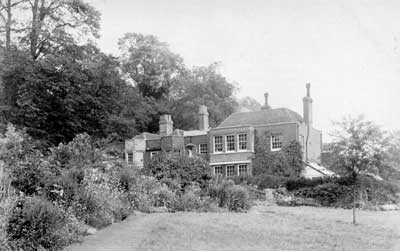
By 1779 Isaac had returned to England, his wife Elizabeth having sadly died of smallpox in October 1775 and had been buried in Boston (see previous page).
The story now moves to Froyle. Isaac’s daughter, Mary, had married a George Erving (thanks to Chris Ralph we now know she married George on 26th January 1775 at Boston, Suffolk, Massachusetts) and they owned Shrubbery House, ‘The Shrubbery’ in Upper Froyle. (pictured right in 1912).
Between 1772 and 1781 there was an outbreak of smallpox in the village and, sadly, Isaac, who was either visiting his daughter or living with the family, died. He was buried at St Mary’s, Upper Froyle on October 17th 1781. His daughter, Mary McIntosh Erving was buried in the same tomb on November 11th 1786. She was aged 42.
Today you can still read the inscription on the tomb, even though it is not as clear as in 1983 when it was recorded by Alan McGowan:
In memory of ISAAC ROYALL Esqr, late of Medford in New England, who departed this life October 16th 1781 aged 62. Also in memory of MARY McINTOSH ERVING, daughter of the above ISAAC ROYALL and wife of GEORGE ERVING Esqr, late of Boston in New England and now of this parish. She departed this life November 11th 1786 aged 42.
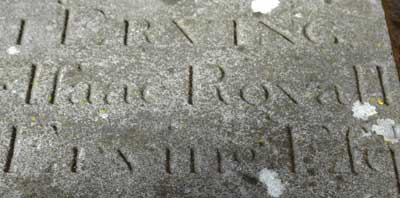
The Royall family left their mark in the new America in the town of Medford, Massachusetts (just North of Boston), where today the Royall House is preserved as a National Historical Landmark. Follow this link to their web site.
Sir William Pepperell’s widow built a house in their home town of Kittery Point, Maine, in about 1760 and lived there for some thirty years. Follow this link to the US National Park Services web page describing the house.
The town of Pepperrell, Massachusetts, was named after him – follow this link for more information.
We hope to find out even more about this fascinating, and at times, confusing, American connection with Froyle.