
Home Defence during the Second World War, as seen through the eyes of Mr.E.R.Hill, writing in the Froyle W.I.Scrapbook in 1952.
During this War the loss of husbands and sons from the homes of Froyle was much less than in the previous one. The names of Hubert Brownjohn, C.Goodyear, R.S.Morgan, W.A.Morris, and W.Stevens, appear on the War Memorial together with those of Mr.Chubb’s son, Richard, who was killed in an air raid while on civilian war service in London, and of Phyllis Savage, whose death was due to an accident at her WAAF Camp.
The village was too near points of danger such as Lasham and Bordon to be considered safe for official evacuees, though there were a number of voluntary evacuees. Because of this danger, the Home Defence was highly organised. Mr. E.R.Hill was Head of a capable band of Wardens. Mrs. Sangster organised a large company of First Aiders, which was able to carry on after she and Father Sangster left the village. At the Vicarage, and later at Park Edge, Mrs.Sumner’s house, there was a First Aid Station, with sub-stations at Mrs.Shell’s, Hussey’s Lane, Sylvesters, and Oak Cottage.
In May 1940, Mr Hill formed a volunteer Fire Brigade. Beginning with a length of hose and a group of men looking at it, by July the Brigade was able to give a demonstration at Marelands, Bentley. Major Wade, lately retired from his command of the Farnham Fire Brigade, was loud in his praise. Meanwhile, better equipment was acquired and in September 1940 the Brigade was recognised as a branch of the Alton Rural Fire Service. In July 1943 Froyle was officially enrolled in the National Fire Service.
Its greatest triumph was on August 6th of that year. Here follows the account given by the Hampshire Herald:
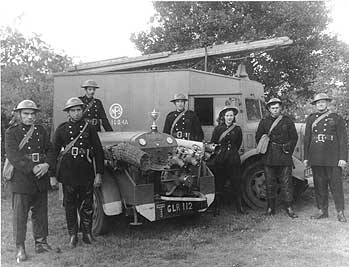
“A Fire Brigade competition was held, in which teams from Froyle and Binsted took part, in addition to the regular and part-time members of the N.F.S. At Alton, and a surprising feature was that the full-time members of the service were beaten by the part-timers, while the Cup, which was presented to the successful contestants by Mrs.Busby, was awarded to Froyle, the most recently formed team and, incidentally, the only one which included a woman.”
(Picture on the right of the winning team: from left to right, Mr.Frank Laney, Mr.S.Beckhurst, Mr.Price, Mr.Lawrence, Miss Banning, Mr.Joe Lee, Mr.E.R.Hill.)
In spite of its position, Froyle was fortunate in having no bombs on the village. One heavy bomb fell in High Woods making a crater large enough to contain a cottage, and another large one fell nearby. Neither of these had exploded, so they had to be dealt with by the Aldershot authorities. Three bombs and a fire bomb fell in the fields about a hundred yards from the main road. These did no harm whatever, but traffic had to be diverted through Froyle village.
The nights were most alarming when great fleets of German planes passed over the village, going to Coventry and Birmingham. There was a Searchlight Camp of about ten men, later becoming a Radar Station, in a field near the chalkpit in Well Lane. The work done there was of a highly technical nature, but the ladies of Oak Cottage, who had given the men leave to use their bathroom, were not a little amused at the inability of some of them to manage a common gas geyser.
At the close of the War, a Welcome Home Fund was organised by Mrs.Emery and Mrs.William Rhodes, who raised about seven hundred pounds, which was divided among some eighty Froyle men who returned to the village.”
Mr. E.R.Hill
Note: The money left over when all the Welcome Home Fund had been distributed was used to form the Pansy Club, which in turn became the Over 60s and is now still very active as The Good Companions.
Note: You can read more about the searchlight by following the Searchlight item on the Froyle at War menu.
Air Raid Precautions
Mr. E. Hill was Head Warden for Froyle and his daughter, Ann, provided us with a superb insight into just how the village pulled together in those dark days of the war. She had details from Alton Rural District Council’s Air Raid Precautions, listing the people in Froyle who could be called on in an emergency and I make no excuse for reproducing it in full!
FROYLE’S TEAM
| Name | Address | Notes | Task |
| Savage, Albert | Millcourt Cottage | Available at night | First Aid |
| White, Harriet | Lower Froyle | Can’t drive, no car | First Aid |
| Savage, Herbert | Millcourt Cottages | Farm Worker | First Aid |
| Cousins | Coldrey | Has motor cycle | First Aid |
| Savage, Doreen | Millcourt Cottages | Works Crosby & Co | First Aid |
| Cox, Hilda | West End | Will go out day or night | First Aid |
| Rix, Gordon | Homestead Cottage | Plumber | Fire Guard |
| Savage, William | Brewery Cottages | Works at F.Stevens | Rescue Party |
| Pinnells, Alfred | Lower Froyle | Was in Army. Pedal cycle | Rescue Party |
| Vickery, Charles | Lower Froyle | Available at night | Rescue Party |
| Shell, Andrew | Husseys Farm | Has car. Day or Night | Rescue Party |
| Rhodes, Frederick | 1 Brewery Cottage | Can do day or night | Rescue Party |
| Dedman, Albert | Husseys Lane | Worked Husseys Farm | Rescue Party |
| Brownjohn, William | Rock House Farm | Farmer. Has motor cycle | Rescue Party |
| Pinnells, Frank | Lower Froyle | Ex-Service. Farm worker | Warden |
| Harvey, Theodore | St.Catherines, UF Car. | Commander Retd | Warden |
| Cousins, Edward | Coldrey Lane | Has motor cycle | Warden |
| Tabb, Frank | Rose Cottage, LF | Alton Hairdresser. Has Austin car. Trained as warden in London | Warden |
| Cox, Albert | Whiteway Cottage | Warden | |
| Hargrave, George | Froyle Mill | Can drive. Day or night | Warden |
| Blanchard, William | The Square, UF | Can drive | Warden |
| Blunden, Charles | Ovington Bungalow | Can drive. Builder | Rescue Party |
| Robinson, Peggy | Prince of Wales Inn | Day or night. Steel hat given | Fire Guard |
| Milne, Francis | Chappell Cottages School age | First Aid | Messenger |
| Lythgoe, H | Park Edge, UF | Worked in garden | First Aid |
| Lawrence, W.G. | Lower Froyle | First Aid | |
| Ezzard, J | Upper Froyle | Fireman | |
| Beckhurst, Richard | Lower Froyle | Rescue Party | |
| Squibb, Maurice | Upper Froyle | Motor cycle | First Aid |
| Batchelor, J.W | Rye Bridge | Motor cycle | Messenger |
| Bannon, Mrs | Brocas Farm | Can drive. Has car | Ambulance driver |
| Lady Smiley | Froyle House | Can drive. Has car | Ambulance driver |
| Vivian, Ernest | Lower Froyle | Master butcher. Can drive. Has van | Ambulance driver |
| Glasspool, Ernest | Millcourt Cottages | Gardener | |
| Milne, Mrs. Mercy | Chappell Cottages | At Vicarage. Has cycle | First Aid Helper |
| Vincent, William | 2 Park Lane | Any time | Phone duty |
| Rose, Walder | Manor House | Any time. Anti-gas course | First Aid. |
| Hill, Ernest Rivers | Elm Croft | Builder, Undertaker. Any time. Has car. | Head Warden Phone duty |
| Andrew, Wilfred | Blundens Cottage | Farmer. Has car | |
| Hill, Mrs. Hilda | Elm Croft | Trained | First Aid |
| Mabb. Minnie | Gothic Cottage | Any time. No car | First Aid Helper |
| Nash, Miss E | Lower Froyle | First Aid Helper | |
| Knight, Mrs L | Lower Froyle | First Aid Helper | |
| Pelton, Miss M | Oak Cottage | Day or night. No car | First Aid Helper |
| Cherrill | Lower Froyle | No car | First Aid Helper |
| Shilling, Mrs A | Lower Froyle | No car | First Aid Helper |
| More, Mrs R | Hodges Farm | Has a car | First Aid Helper |
| Sumner, Nina | Park Edge | Day only. Has car | First Aid |
| Walker, Vera | Oak Cottage | Any time. Will cook | Ambulance |
| Burns, Mary | Sylvesters Farm | Day or night. No car | First Aid |
| Cherrill, Miss G | Ewelme, LF | Day. No car | First Aid |
| Goschen, Ethleen | Sylvesters Farm | Day or night. Can drive anything. No car, but can offer a horse | Ambulance driver |
| Laney, Frank | Coldrey | Day or night. No car | First Aid |
According to his daughter Ann, Mr. Hill was delighted to be offered a horse by Mrs. Goschen, as he said it would save time cutting across country.
More about the Home Guard
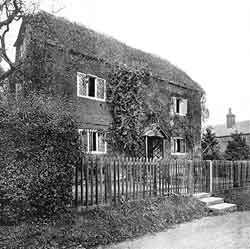
The Scrapbook mentions “the ladies of Oak Cottage” – these were a Miss May Ollis Pelton and Miss Vera Walker. Not only did the ladies share their bathroom with ten men, but they were amongst a number of W.I. ladies who did their bit for the war effort by making jam. Up until 1941 this posed no problems as the ladies obviously made the jam in their own homes, but in that year, the Ministry of Food issued instructions that jam making would now have to be carried out in public buildings. Miss Pelton wrote to the Parish Council on behalf of the W.I., asking that the hut on the Recreation Ground be fitted with a sink and cupboard. After much discussion the Council agreed providing the cost did not exceed thirteen pounds. It obviously did not, as we read in the Farnham Herald of 4th October 1941:-
“Between 800 and 900 pounds of jam were made during the season by members of the Froyle Fruit Preservation centre at The Hut.”
Oak Cottage in the summer of 1915.
The Home Guard Hut
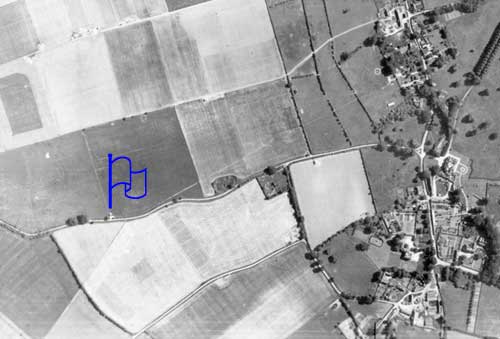
The hut, a corrugated iron Nissen Hut, was located on the road to Yarnhams, above Upper Froyle. You can still see the concrete hard standing where it stood. (In the picture the location is marked by the base of the ‘flag’).
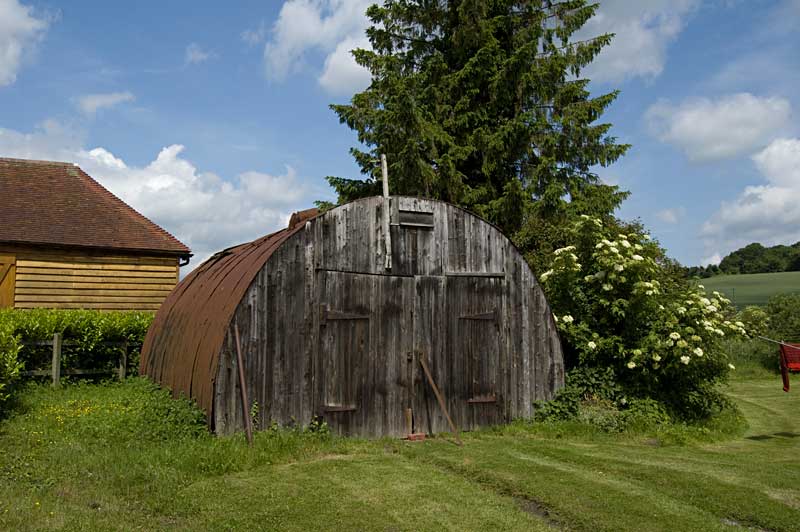
After the war, in about 1947, it was dismantled and rebuilt in Upper Froyle as a garage.
In 2008 it was still there, although the stove had disappeared many years ago! Not many villagers realised the significance of this building, but we were able to photograph it at the beginning of June 2008. (see below)
Personal memories bring out the real feeling of life during those years of war. Here are a few recollections from the book “Froyle, 100 Years of Memories”.

Pat Pritchard, nee Milne (picture right), who was five years old when war broke out, remembers, “Any spaces alongside the road were use to place old farm carts, huge concrete blocks and rolls of barbed wire in case of invasion. The women in the village worked in the fields, as the men had gone to war, and some of the older boys left school at lunchtime to harvest potatoes. The women also worked very hard arranging functions, such as whist drives and entertainments to raise money for a “Welcome Home Fund” and the atmosphere in the village was wonderful. At Christmas Lady Talbot at Froyle Place gave us an exciting party for the whole school with Father Christmas coming down the main staircase and giving each and every one of us a present.”
Maureen Fry, nee Chappell (picture right), who was at Froyle School from 1940 until 1946 said “We had to walk in single file on different sides of the road on our way to school in case of air raids. In Lower Froyle we were told to always walk on the left – I still do!”
Jack Cooper, at school from 1934 until 1941, said, “Mr.Knight felt that the older children should learn our Allies’ National Anthems. I remember learning the English words to the French National Anthem and singing them in class. The school windows were all taped up and classes finished earlier in the winter to get us all home before the air raids started.”
Ann Hill (picture right), who was born after the war started, still has vivid memories of those years. “I remember lying in bed listening to our planes in the dark”, she said. “Of course, we had to be very careful with the blackout up at the windows at night. I remember the signs were taken down on the roads. My father made an air raid shelter in the garden and we all went into it when we thought the bombs might come. We had oil lamps down there, as well as a wood burning stove to help keep us warm. There were bunk beds, I remember, but no running water. You had to take food and water with you if you had time, as you had no idea how long you might have to stay down there.”
As we saw earlier, Ann’s father was the Air Raid Warden for Froyle. Her mother was also busy during the war, nursing and working with the Red Cross in the area. She received a medal for her service at the end of the War.
Pam Vivian’s family also had an air raid shelter in the garden of the Butcher’s Shop. “Ours often had a foot of water in it” she said, “and we only slept there a few times in the early days when the planes came over Aldershot and Odiham.”
David Bennett (picture right) was one of those children who came to Froyle from London.
“It was during the war-years that I first visited Froyle and spent a few months here. During this time I had to attend Froyle School. It seemed so safe in the country. It was good to sleep without fear of German bombers and Doodle-bugs and no interruption at school – well, I didn’t really mind that! The highlight of going to and from Froyle School was to watch the Village Blacksmith at work.
In Church Street, Alton, the Evangelical Free Church was then called the Foresters Hall. All types of events were staged there. One such event was a party for London kids only. I had a great time – the bonus of extra food a treat on its own.”
Francis Milne (picture right) remembers standing in the hop fields and watching the Battle of Britain! “The Home Guard was formed and I was a messenger between Home Guard, A.R.P. and firefighters. Grandad and I caught rabbits, grandad prepared them for the pot and we sold them at 2/6d each, they were a main source of food during the war years.”
Finally, one quote from the book which says everything about the people of Froyle who lived through those years!
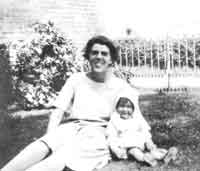
Joyce Kemp told me a lovely anecdote, which, I believe, sums up a lot of people’s attitude during war time. She remembers, “how everyone worked hard to help keep Britain fed. They often worked on even when the sirens had sounded. They were used to carrying on in bad weather so they were not going to stop for a few bombs!
One day, during the war, Auntie Ena called in to see us in Alton after her usual trip to market. We were chatting with friends about the bombs which had dropped nearby in the night.
“Well, I can’t stand here talking” Aunty said “I’ve got a load of logs to move”, and off she went, A friend of ours remarked “Hitler doesn’t stand a chance – not while there are people about like your Aunt!””
Picture right: Ena Westbrook in 1930 with her niece, Ruth Smither.