
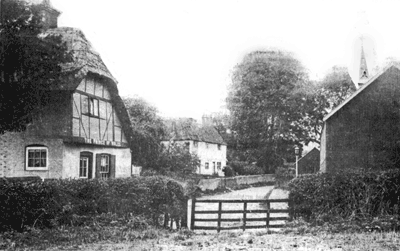
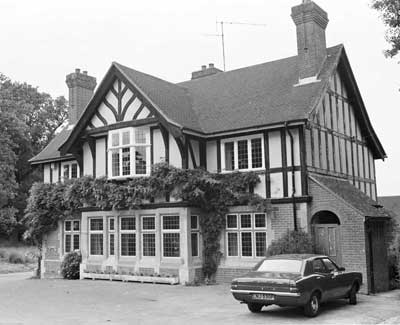
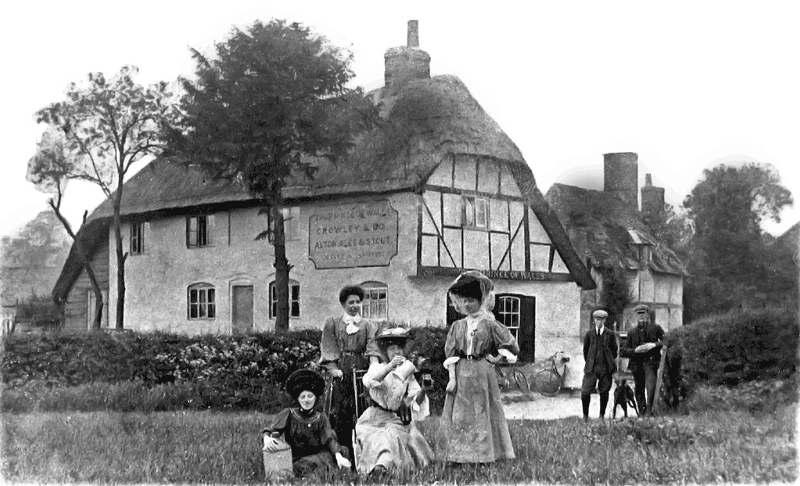
In the village of Lower Froyle stood the “Prince of Wales” public house. Originally described as a ‘malthouse’, it was not recorded as the “Prince of Wales” until the 1891 Census. This older building (left picture) stood nearer the road than its replacement.
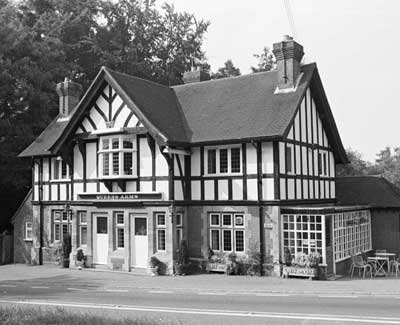
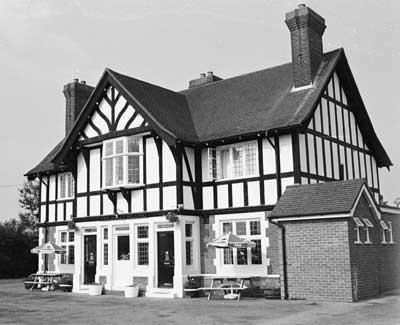
The plans for the new “Prince of Wales” (right picture) were drawn up in October 1908, by the Farnham architect Arthur J.Stedman, for Crowley’s Alton brewery. It was one of four public houses built in the area at that time, identical apart from their entrance doors. Of the others, two have already become private homes. By 1998 the pub was no longer viable and it was sold for conversion into a private house. During this work we came by solid (literally!) evidence of its date of construction.
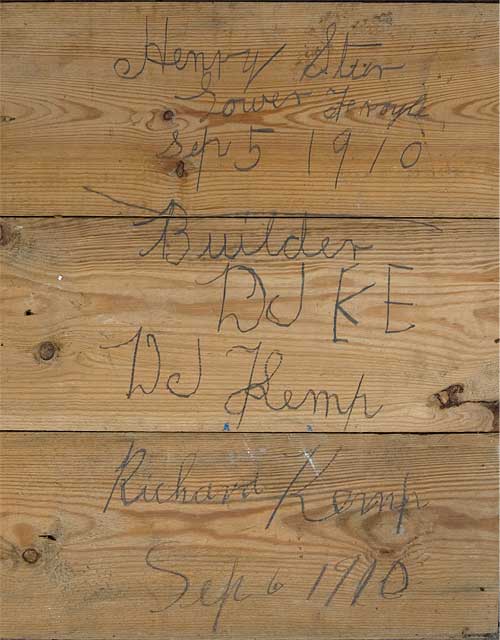
This section of floorboard was under the cold water tank in the roof of the “Prince of Wales”. It clearly shows the date – September 5th & 6th 1910 – and the name of the builder – D.J.Kemp and Richard Kemp – and one of his workmen – Henry Stur. D.J. (Daniel) Kemp was a well known Alton builder.
This ties in beautifully with our existing knowledge that the plans for the ‘set of four pubs were drawn up in October 1908. It also confirms our given date for the photograph of the nearly new “Prince of Wales” as 1915.
The finished conversion
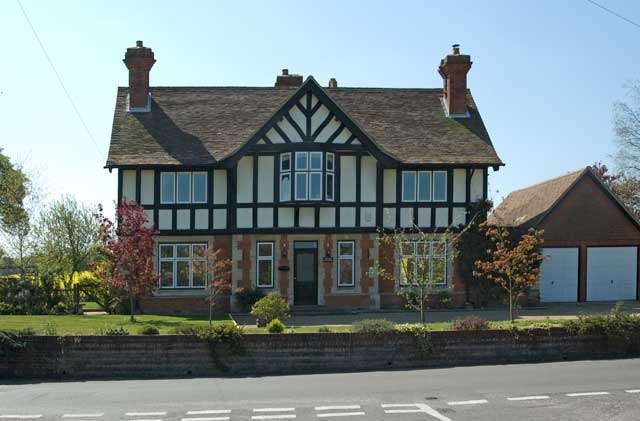
The “Old Malthouse”, as the former “Prince of Wales” is now called, on a sunny April morning. As you can see the former car-park has been filled in to form a garden and the building provides a striking centre-piece to this part of Lower Froyle. “Why Old Malthouse……?” I hear you say. The owners approached the Archive for any ideas for a different name – they weren’t too struck with the idea of “Old Prince of Wales”, and, looking through the Censuses, we continually came up with people living “at Malthouse”, and so the name was adopted.
The Four Princes
The plans for the new “Prince of Wales” were drawn up in 1908 by the Farnham architect Arthur J Stedman for Crowley’s Alton Brewery. It was one of four identical buildings constructed at the same time in the area. In 2005 only “The Jolly Miller” is still a public house.
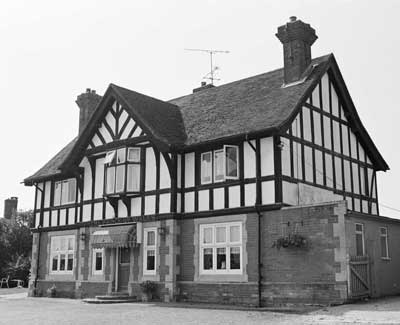
Then and now
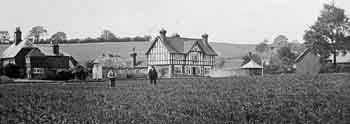
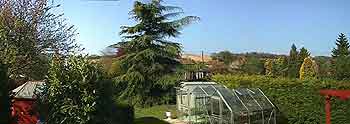
The left hand picture was taken in 1915 when the building was very new and the modern picture was taken in April 1999. There are quite a few changes:- The Prince of Wales (behind the fir tree in the modern picture) is no longer a public house. It became a private residence, named “The Old Malthouse”, in 1998. The field has become the site of eleven bungalows built between 1960 and 1962. The modern picture is taken from our back garden, which is where the two workers are standing in the old picture. St.Joseph’s Church (on the right) has been demolished (1967). The thatched barn (see below for 1981 demolition pictures) and the well (looks like a bandstand) have also gone.
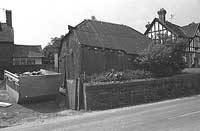
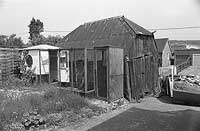
Larger pictures
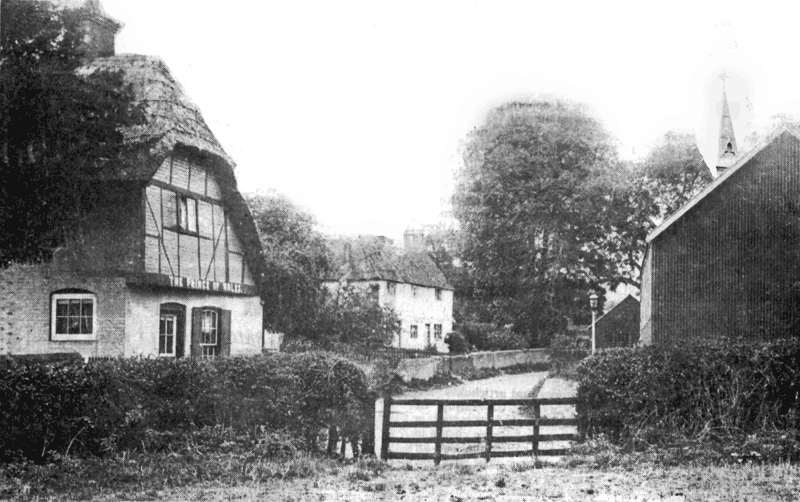
This is, we believe, the oldest picture we have of this area of Lower Froyle. The “Prince of Wales” sign on the front has survived and is at present over the door of “The Old Malthouse”, as the replacement “Prince”, recently converted into a private house, is now known.
This picture is from a “Varney” series postcard. These were published around 1905, but the picture, we think, is the oldest of the three of the “Prince”. The previous two did not show St. Josephs, the little tin church built somewhen after 1870. The biggest clue as to the age of the picture is the finish on the gable of the “Prince of Wales”. In the picture below it is rendered with a white finish – here it is either brick or tile (the definition is not good enough to be sure which). The tree to the left of the pub looks larger than in the other pictures, but, close examination of the picture with the group of ladies shows that the lower branches of the tree have been lopped.
The lower picture is one of the most delightful we have in the Archive collection. It was obviously posed, but what a delightful image of an age long past.
We wonder if the lady without a hat was Sarah, the wife of the landlord Middleton Young (from 1891 Census) – who knows, one day we might find out?
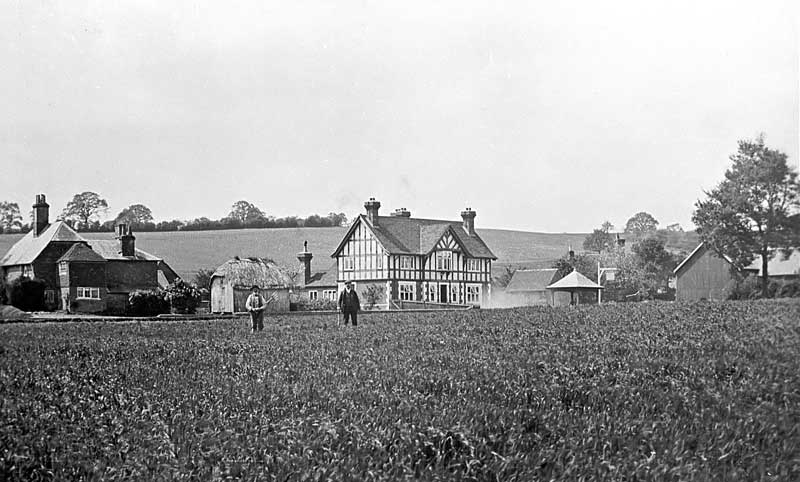
This photograph was taken from what is now our back garden! As well as the “Prince of Wales” you can see St.Joseph’s Church on the right. The cottage to the left is actually two – the front, facing us, is nowadays called “Old Post Office Cottage” and was exactly that in the 19th century – the Post Office in Lower Froyle. Behind it is “Warren Cottage”, and we know from the deeds that in the late 1700s the Clapshaw (or Clapshoe or Clapshew) family lived there – in particular Aquila Clapshoe, who was born in 1714 at Froyle. His son, also named Aquila, set up the Aquila Clapshoe workshop at Turnham Green, London, in 1780, making cricket bats.
Aquila (the 1714 one!) was most likely a cricket player who made his own bats, as did everyone else, but his expert craftmanship put him in a class of his own.
We have in the Archive a transcript of an indenture of lease made on the 15th April 1781, between the Clapshews and William Cook and Thomas Crosswell concerning various parcels of land in Froyle.
The Clapshoe firm, who by the 1800s had become Clapshaw (!), became Aquila Clapshaw & Salmon in the latter part of that century. For a much more detailed history of the cricket bat business, follow the link below.
There is an Aquila Clapshaw bat, dated 1860, in the museum at Lord’s cricket ground. Sadly, in the 21st Century, there is no Cricket Team in Froyle.
- Clapshaw Bats