
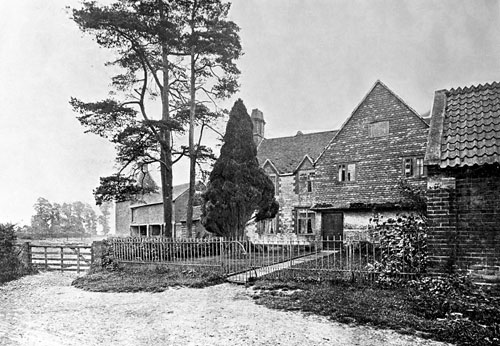
This photograph was taken for the sale brochure in 1915 when the Froyle House Estate was sold, but Sylvesters (also spelt Silvesters) is much older than that. It took its existing form in 1674, according to a date let into its back elevation. This date presumably refers to the time when the wing was added at right angles to a timberframed early Tudor house, then, or subsequently, hung with weather-tiling on its north and west sides and at the back faced in stone. This use of stone – from a quarry beside the main road – and the whole character of the house, belong rather to the country across the Wey, with its geological affinities to Sussex, than to Froyle and North Hampshire: implying that the latter’s tradition of brick building was not yet established. The 1674 wing has moulded brick window jambs and lintels, with stone mullions on the south and original wooden casements on the north. A Sylvester appears in the registers in 1670, and others of the name up till 1760; in 1800 Sylvesters was one of Sir Thomas Miller’s farms. It is worth noting the Scots Pines in the front garden – see link below.
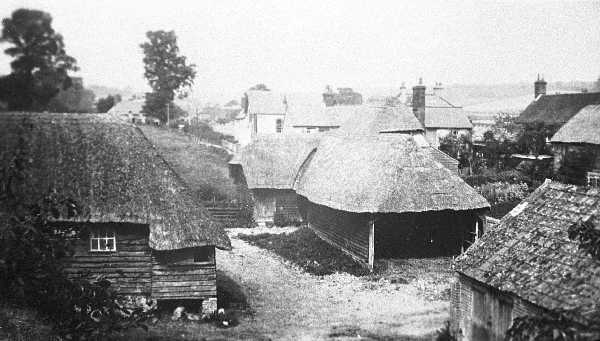
This delightful photograph, taken in the 1920s from the farmhouse at Sylvesters, shows the barns and the yard. In the centre distance you can clearly see the roof of the Methodist Chapel, and to the right, the roof of Holmwood Cottages.
We are fortunate that two ladies, Lilian Smither (nee Westbrook) and Joyce Kemp (her mother was Lilian’s sister, Edith) have recorded their memories of life in Froyle during the early part of this century.
Lilian Smither was actually born at Sylvesters Farm House on May 7th 1900, the third child of Mr & Mrs George Herrett Westbrook. The photograph above was taken from their bedroom which, as Lilian Smither describes, overlooked the yard. “The backstairs ended here on the landing with Mother and Father’ bedroom door exactly opposite. A large room, window overlooking the farm yard, thatched stables and barn, well-carpeted and adequately furnished with two wardrobes”
To read Lilian Smither’s description of Sylvesters Farm, see Memories of Sylvesters Farm.
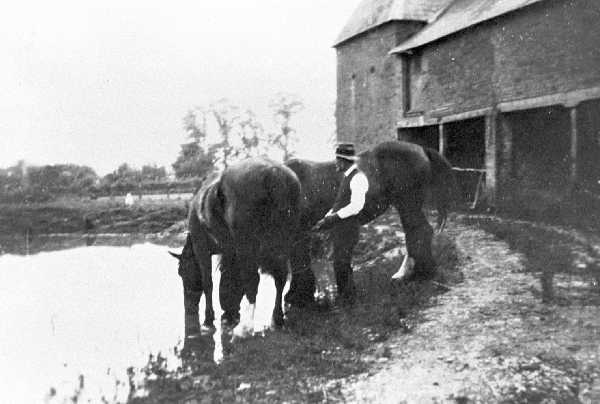
There were several ponds in the villages for the horses to drink from (in fact, there are 20 on the Tithe map of 1847). Lilian Smither describes it thus:- “My father’s horses also drank at the pond; they were usually brought to the waters edge with a halter around their necks and were not allowed to walk far into the pond for fear they might get stuck in the mud, whereas the cows took pot-luck and came to no harm.”
The picture shows Lilian’s father, George Westbrook, at Sylvesters pond.
The trees
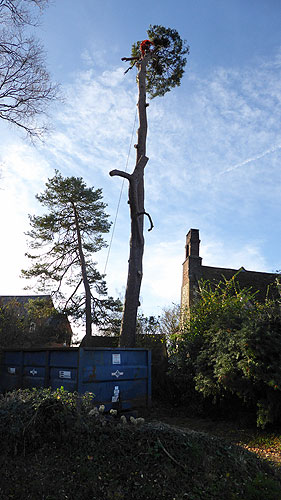
On November 27th 2016 there were big changes at Sylvesters when the two Scots Pines were cut down due to safety concerns. A fungus, phaeolus schweinitzii, which causes rot on the roots had been discovered, and this put both houses at risk from the trees, which could fall without warning.
The trees, whose Latin name is, interestingly, “Pinus sylvestris”, were quite old as the photographs below show. They can live to between 150 and 300 years.
A persistent theme in the folklore of Scots Pine is their use as markers in the landscape. In the Highlands there is a recurrent theme that they were used to mark burial places of warriors, heroes and chieftains. In areas further south where the sight of Scots Pine may have been more unusual and their use would have stood out more, they can be seen to mark ancient cairns, trackways and crossroads. In England they were commonly used to mark not only the drove roads themselves, but also the perimeters of meadows on which passing drovers and their herds could spend the night. There is also the possibly more fanciful suggestion that Scots Pines were planted in England by Jacobite farmers or sympathisers.
“Sylvesters” in its present shape dates back to 1674, which is right in the Jacobite ‘era’, so could the trees have replaced originals planted around that time, and given their name to the house? We shall probably never know!
The photograph below, left, from the Sale Catalogue of the Froyle Estate in 1915, shows that the trees were pretty tall then, while the other picture, taken in the 1880s, shows the Knight family outside “Sylvesters”, with one of the trees just visible to the left, which is still some considerable height. In fact, they seem to have not grown much more in the past 100 years!
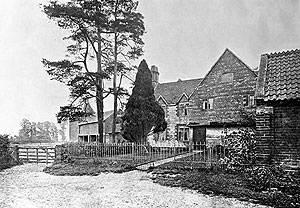
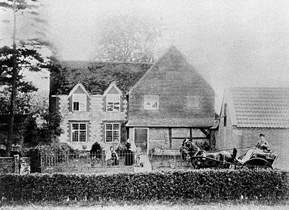
Then and now
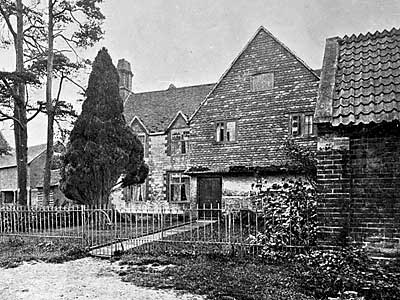
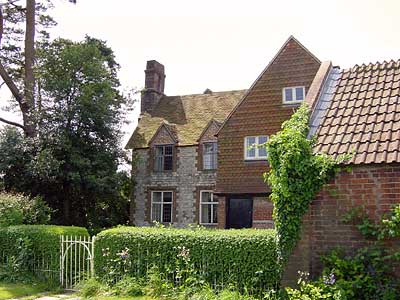
The left hand picture was taken for the Sale Brochure of 1915 and the modern picture was taken on June 3rd 2001. There are actually very few changes, although the modern picture was taken from a position slightly to the right of that used in 1915 (there is a hedge in the way!) There are a few changes:- The plaque on the gable has been replaced by a window. The tree on the front lawn has been cut down. A hedge has been planted at the front. However, the iron fence and gate appear to be the same as 1915 and, the tiles on the barn on the right of frame look as though they are original as well.