
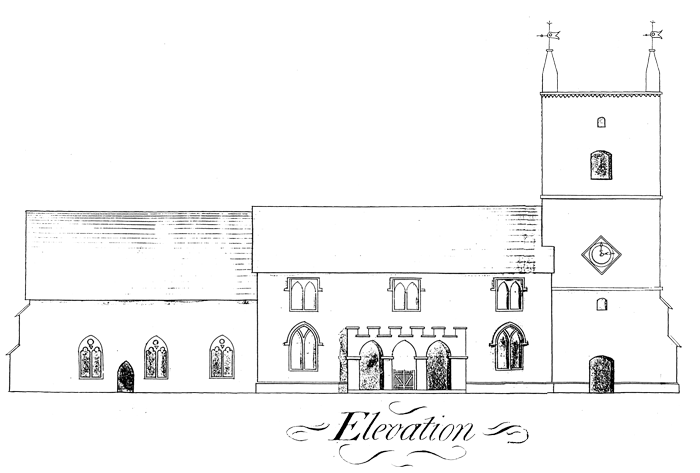
| 1722. | The Church steeple was demolished, and replaced by a tower and clock. The stone above the clock still shows – John Baldwin, 1722. The stone below the clock probably gave the names of the Churchwardens, as the word ‘Churchwardens’ can distinctly be seen. “H.B.” over the tower door no doubt stands for Henry Burningham who died in 1735 |
| 1724 | Five of the bells were hung. Four of them bear the inscription “R. Phelps 1724 Fecit”. The fifth on bears the inscription “Messrs. Henry Burningham, Richard Marshall, R. Phelps FECIT, Rev. Mr. John Greenway, Vic 1724”. |
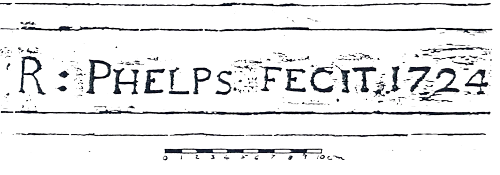
The rubbing above of part of the inscription was done by NADFAS in 1993
1757
The sixth bell was hung, and bears the inscription “Thomas Tower and Thomas Hall, Churchwardens. Thomas Swain made me, 1757”.
Notes on names in connection with the Tower and Bells from Tom Knight
Burningham
The first Burningham entry in the Registers is in 1670 when Henry, son of Henry Burningham was born. This Henry Burningham, born in 1670 is the one whose name is on the bell. He married Ann Baldwin in 1698, and he died in 1716. The original home of the Burninghams was Hussey’s Farm. (Froyle House was built about 1820 on the original site of Cattleys). There is a date on the garden wall at Froyle House – 1820 – with initials GNB and KLB. There was a George Burningham, a lad of 16, in 1820). This Henry Burningham (born 1670), had a son Henry who died in 1736, and a grandson who died in 1740. The 1740 stone is in the Nave of the Church and this is the earliest Burningham memorial. There are at least eight Henry Burninghams buried either in the Church or Churchyard, the last one in 1905. The name is spelt in the Register as Burmigan, Burnigham, and Burningham.
Baldwin
The first Baldwin entry is in 1656. Baldwin’s Farm, at Lower Froyle, is now part of Hussey’s Farm. Thomas Hall was at Baldwin’s Farm in 1750, and the Baldwins seem to have moved to Coldrey. Robert Baldwin died at Coldrey in 1729. Christopher Baldwin died in 1806, aged 82, probably at Bentley. He was buried at Froyle, and his tomb is on the North side of the Church.
Marshall
In 1707, John Marshall married Mary Wells. There was a Well’s Farm as late as 1806.
Towers
The first Towers entry is William Towers in 1653, and there is a Towers entry as late as 1803. There are several Towers stones in the Churchyard near those of the Messengers. In 1743, the Towers lived at Isnage Farm.
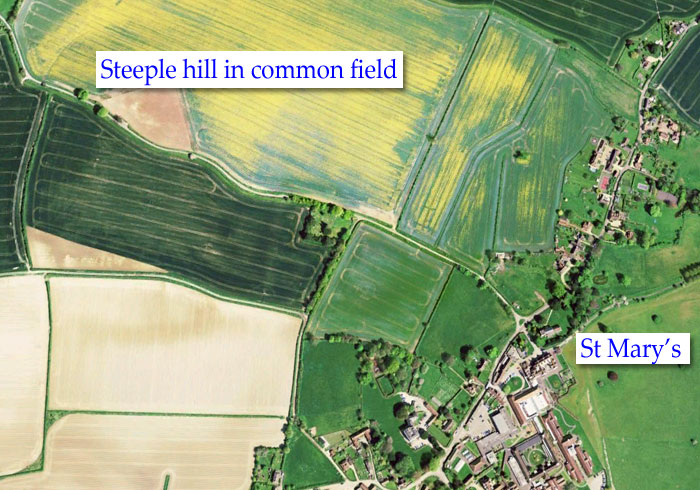
The Tithe Map of 1847 reveals a field on the road to Yarnhams which is named “Steeple hill in common field”. Could this name date back to when the steeple was dismantled, or is it merely a field that gave a good view of the steeple?
In the photograph from Google Earth (above), the un-planted area just below the caption is the location of the field in the Tithe record.
The Bells Restored
In 1995 the Bells of St Mary’s were restored at The Whitechapel Foundry in London. Linda Bulpitt, who was the prime mover behind the fund-raising and the arrangement for their transport and re-installation wrote a couple of pieces for The Froyle Village Magazine in February and March 1995 – they are reproduced below.
Firstly, the peal on the bells of St Mary’s rung by an experienced band took place just after Christmas, and was successful, the 5040 different changes taking a little under 3 hours to accomplish. We then rang in the New Year and our last bong’, was for Sunday service on January 1st, leaving five days to prepare the bells so they could be lowered the following Saturday.
But, shock horror, Martin Hough, who was going to give us the benefit of his expertise in dropping’ the bells (perhaps this is an unfortunate word to use but bellringers parlance can often seem strange), suddenly said he had to rearrange his timetable and would be with us on Thursday instead of Saturday.
Panic nearly set in. But Monday through to Wednesday evening saw us removing wheels, sliders, stays, pulley boxes, clappers, various bits of iron work and old nails from around the frame and on the ceiling below, through which the bells would be lowered. We built staging from Donald Sword’s pallets in the vestry so the bells would be taken straight out through the door. We arranged more pallets at strategic places on the vestry floor knowing the bells would have to rest there for 72 hours before going to Whitechapel.
We had to open the trap door which was in the floor of the clock chamber but probably had not been opened for well over 100 years, would the relevant beams lift? We had to undo 3’ tie rods which went through the middle of the frame and were bolted from underneath on the ceiling of the clock chamber. We weren’t sure these had ever been removed before. But, incredibly, armed with several cans of WD40 which had been sprayed onto all the relevant coach bolts nails and screws during the week before, and with a certain amount of ‘welly’ (or do I mean ‘wally, bellringers are all brute force and ignorance) everything seemed to happen. We took delivery of a 13’ RSJ, four steel props (to support the main beams above the frame where the stress would be taken), and two lots of block and tackle, one 25 metres long and that is an awful lot of heavy metal. Three of us hauled these up into the belfry using various ingenious methods (our biggest fear was that we would accidently angle the RSJ through the brand new porch windows!). Finally, by Thursday lunchtime we were ready for Martin. The first job tackled was to sling the RSJ between the two beams in the roof of the belfry, and that was not an easy task. The block and tackle was set up, and attached to the 11 cwt tenor bell which had to be lifted clear of its pit, so we could slide the frame to one side to expose the last trap door.
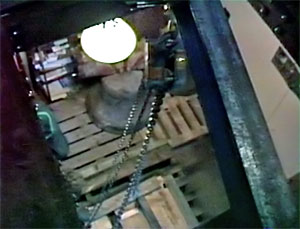
And so the real work had begun. I had the easy task of hauling on the block and tackle to raise the bells, whilst three men were straining to keep them from swinging either onto the frame, through the props or into me. (Occasionally this seemed to be a rather attractive hazard, aching arms and shoulders can become quite painful!). Once positioned over the hole, left after the frame had been pushed to one side (this took an enormous amount of strength and a huge sledge hammer wielded by the bionic powers of Martin), there was only the matter of lowering the bells down to the vestry. It took about 15 minutes of continuous pulling on the tackle chains to lower each one (you then had 15 minutes of pulling to raise the tackle for the next bell!) The tenor managed to pass through all three traps with a small amount of space on each side, sometimes having to angle the bell to achieve this. By 8pm all six bells were in the vestry and all four of us were walking zombies.
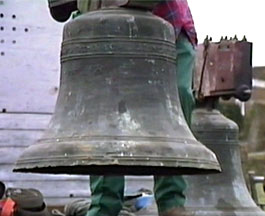
A certain amount of work had to be done on Friday and Saturday to make everything ready for Monday morning when a lorry, supplied free of charge by Sharpe and Fisher (what was Philips building yard at the other end of Alton), would arrive to take the bells up to Whitechapel Foundry for us. Donald Sword, very kindly carne with his fork lift tractor, together with Michael to help in this part of the operation. Each bell had to be raised again, put on a little truck, wheeled out of the vestry, having removed the door as there was only 1/2″ difference between the width of the door frame and the diameter of the tenor bell, and then taken out through the churchyard so it could be lifted up, using Donald’s tractor, onto the lorry. All went well and 2½ hours later the bells were on their way to Whitechapel.
One or two extra problems have unfortunately arisen since then, which are going to involve extra expenditure as a number of supporting beams have to be re-supported as the little old beetle, wind and rain have managed to demolish an awtul lot of the wood. Luckily some of the preparation work can be done by ourselves and we are busily ‘defrassing’ all necessary wood, i.e. scraping back all the dead wood (which seems to be coming off in handfuls in places) to good strong wood. As is the way of life, the areas worst affected are always in the most inaccessible places, so that we are continuously stuck in incredibly awkward stances, but the little pound signs flash in front of our eyes and we beaver on and slowly the light is appearing at the end of the tunnel.
We are hoping the bells will be returning to Froyle on about 20th February so hopefully by the beginning of March we shall be back to Sunday ringing.
Next month Linda reported on the return of the Bells
As you can’t have failed to notice, the Bells are back. The last ‘update’ on the bells was in February and I left you with the cliff hanger of the main tower beams slowly disintegrating as the deathwatch beetle gnawed his way through our tasty oak!
There was a good deal of running around by a number of skilled people to sort the problem out, Church Architects, Constructional Engineers, Winchester Church Advisors – without their approval nothing can be done – Builders, Beetle Annihilators and even the Queen (Kevin who finally carried out the necessary work because his skills are second to none, was taken off restoring the kitchens at Windsor Castle for the week!)
Everything melded and by Friday 17th February two steel beams had been put in place to support the old timber beam. The last man had left and we were ready for the bells to return on Monday 20th.
Our on-site bellhanger from Whitechapel Foundry was Martin Waldron. Part of the savings we were making was to provide local help for the duration of the installation. Although he was far too polite to say anything, I am sure Martin was rather dubious about being ‘assisted’ by a retired man (admittedly very early retired) and a woman! Our days started at 8am and finished on the whole about 5pm.
The first morning we sorted out various bits of equipment which would be needed and put in two new tie bolts to secure the frame to the beams in the clock chamber below. The bells arrived back from the Foundry just after lunch and we then spent the next few hours reversing the initial procedure to move them back into the vestry. Many thanks again to Donald Sword, Michael and Rosemary and Simon Heard who came down to help pull and push the bells back up the gravel path to the vestry.
During the next couple of days, new bearing plates were let into the frame, metal work cleaned down, primed and undercoated and the lifting tackle placed in position ready to hoist the bells back up.
We managed to raise all 6 bells on the Friday, placing the 2, 3 and 4 in their pits, resting the 1, 5 on top of the frame and leaving the tenor attached to the tackle as this would have to be raised again in order to slide the frame back over the last trap door.
The following Monday we coach bolted down the bearing plates, put on the wheels and generally had a tidy up.
Tuesday through to Friday saw the cutting of pulley holes, the measuring for the wood needed for the pulley back plates, the realignment of some of the chutes in the clock chamber to make sure we had a vertical drop for the ropes, and putting on the stays, the slider boards and sliders. We put in the clappers and half rang up the bells by hand to check they would strike in the right place, adjustments were made with fibre washers.
Unfortunately the all important wood for the pulley blocks had not yet arrived and we were wondering if the ‘trial ring’ could go ahead on the Monday evening as had been planned. Martin decided that so long as they were with us by first thing on that Monday we could make our deadline. Needless to say it proved to be quite a long day but by 6.30pm everything was ready, the ropes had been hung and there was just time for a hasty gourmet meal of baked beans on toast and I can tell you they tasted jolly good as we had been enduring weather of zero degrees with sleet and hail travelling horizontally through the belfry (yes effective weather proofing is at the top of our list now).
7.30pm and a number of ringers and well wishers were assembled, some were from Froyle and some had been ‘imported, to make sure that a good 6 bell method could be rung. Having been so involved both Chas and I were feeling more than nervous. Although it was irrational, we felt personally responsible for the spending of so much money which so many people had been involved with, either through raising or giving. Thank goodness everything went well and Martin seemed pleased. All we now have to do is adapt our ringing to the ease of our newly hung bells and there will be no holding Froyle back.
On Sunday, March 12th, just nine weeks after the bells became silent we once more rang for morning service. We were delighted that many people went out of their way to say how nice it was to hear them once again and how so much more tuneful they sounded. (This is because the clappers are now actually hitting the bell in the right place!!).
These last two and a half months have been physically quite hard work with a large dollop of mental stress thrown in for free, there is still a good deal of cosmetic work to be done (like effective weatherproofing!), but I can honestly say both Chas and I have enjoyed every minute of it, and very much appreciate that we have been privileged to take part in a project few people have the opportunity to experience. We have had wonderful support from everyone, and hardly a day went by when a friendly face, both bellringers and villagers, didn’t pop up into the belfry to see how we were getting on, and that was really nice. So to you all, and especially perhaps to Christopher (the Vicar) for all his visits and encouragement we would like to say a big Thank You.
The Bellringers
We ring before all services except the early ones.
If you feel like having a go yourself,why not come along and take a look – we practice every Friday evening between 6.30 and 7.30.
In the Spring of 1999, as part of “Froyle, the Final Year”, one of the two videos produced as part of Froyle’s millennium celebrations, I recorded an evening’s practice in the bell tower.