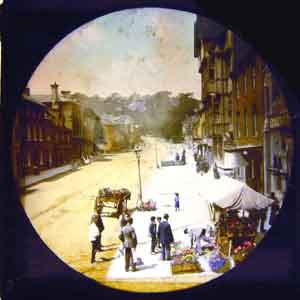
This is the Rev. A. E. Wright’s own commentary on his lantern slides of Binsted and the villages around it, written as a lecture to his parishioners in Waterlooville. The paragraphs are numbered as in the original, with each slide’s picture beneath its paragraph. Not every paragraph has a picture: some of the slides are missing and some are damaged beyond recovery.
Slides 1 to 11
1. Ladies and Gentlemen I am going to invite you to pay a visit to my old Parish, situate in a very picturesque Country on the Hophills of North Hampshire, midway between Farnham and Alton, and about 10 miles from Aldershot.
2. We will suppose (if you please) that we have just alighted from the “London train”, – after a rather slow and tedious journey of 40 miles, – stopping at every station below Woking junction. The little roadside station of “Bentley” at which we find ourselves is about 2½ miles from Binsted on the Hill. The authorities all turn out in force to welcome us, Station Master, -Booking Clerk and Porters, – even the Nursery landing a contingent.
3. Green Lanes around us on every hand and a country road skirted by hedges, through which we see occasionally a peep of a tiny river (the “Wey”) which rises at Alton and gives its name to Waverley Abbey and Weybridge but which is at present a shallow and sluggish streamlet.
4. Here and there the hedge is broken by a gate, and “a Rustic Cottage” comes into view. We are entering now the outlying Hamlet of Isington and this is the first house in the parish – I may explain here that it is a very wide and straggling parish covering about 8 square miles, – with 5 hamlets attached to the church, – some of them 2 miles away in every direction. The “Homes of the Poor” are very pretty and attractive from the outside; but with leaky thatch letting in the rain above, and draughty back doors letting the snow drift in as far as the table-legs, – and the floor lying about 6 inches below the garden, – they are not exactly models of comfort.
5. But stay, here is His Majesty’s Mail coming rattling along and it is a narrow lane – Oh! I see they have pulled aside almost into the ditch to let us pass – “Well Little Ones! Where are you going to at that rate? Off to Jerusalem?” “No! We don’t want any donkeys; We’re going home to dinner.” “Oh very well! goodbye! It’s a pity you didn’t go to Jerusalem though, after all; for you might have eaten the donkey for dinner.”
6. Now we come in sight of a “Hayfield” and there is nothing more refreshing after a dusty Railway journey than a sniff of the sweet newly-mown grass. We take a look round the horizon and try to appear “Weather-Wise” “Thunder’s not far off’ (we say) “they’d better be quick”.
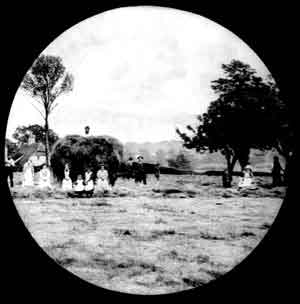
7. As we pass “Vallenders” old Mrs. Barrett comes out and says “The Curate’s at home! Will you please walk in and join us at tea; We’ve got a fine sight of folks here today; for it’s the tea in the Hayfield” – We join; and
8. straightaway we find ourselves in the centre of a Large Party of all ages and sizes “Haymaking” is a great time for Grandmammas, and Great Uncles, – and “Father’s Sister’s Husband’s Mother” – They all come down into the country to help toss the hay; – and if not to do that, – to help drink the tea – Let me introduce you to the ladies -There is Lily Clarke in the seat of honour, next the Parson Himself. Then there’s little Flo Smith on Horseback – and “Ti” cuddling up to old Miss Hammond who’s nursing a sick child named “Rosie” sent down from London to put the colour back into her pale cheeks – In the foreground are the “Station Master’s children” (of 20 years ago).
9. After tea, work goes on briskly. Mr. Win. Smith is up on the top of the load and his brother Alfred makes the tree. It looks like “old Giles” the Blacksmith on the left – and Sis Smith between him and the cart – (all the other children we saw just now at tea) – Bob seems to have charge of the horse.
10. Sometimes the 4 “London Kiddies” go out into the forest and picnic. This looks something like the wood called “Lipscombe’s Bottom”. It is a terribly wet place in winter time “over shoe top it be”.
11. I thought I heard a cackling amongst the Hens in the hen house just now; – Oh no! I see it’s only one of the children hiding away to jump out on somebody.
Slides 12 to 19
12. We shall never get to Binsted at this rate. We must just take a look at the forge and wheelwright’s shop at the corner. The “Smithy” was of old time the centre of village life and the great local parliament where politics were discussed. The old Smith is passed away. Indeed he was past wielding a hammer when we knew him 20 years ago. Three generations turn out to see us pass. Amy Wakeford (whose father was an engine driver in India) -and her aunty” and “granpa”.
13. Hullo! We’ve been so long on the road that “Winter” has overtaken us – “Binsted” is mentioned in “Dooms Day”. It is called Benestede-Kings (that is to say “a holding subject to the King’s good will and pleasure”) another estate was called the “Binsted Popham” – The pond at the cross-roads is all frozen over and the road to Alton is sunk between two high banks.
14. The Schoolboys are out skating – Teddy Bulbeck leads the team and Frank Usher is not far behind him – My Dog has seated himself on the bank to watch the sport – you might fancy he was a “foolscap” on Teddy’s crown.
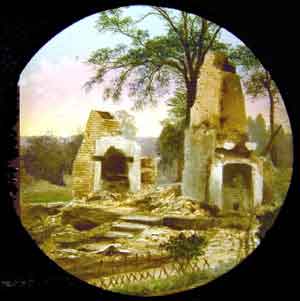
15. The “Ruins” are not the result of fire, but “faculty” – The old Glebe Farm having to be pulled down to save dilapidations in Mr. Walsh’s days – It was, I suppose, a necessary step as the old building was in a bad state of repair; but it was a “grand old house” a relic of the past. (As I think you will say when you see it presently as it was a quarter of a century ago).
16. We must go round by the churchyard wall, – and see the girls slide, Ada Othen well to the front.
17. The Church stands high on the top of the hill, – visible from afar, – a fine old pile of buildings dating from the Norman Conquest, or soon after. The Central Large Window is the Chancel. The second window on the South belonging to the “Founder’s Chapel” and the long straight roof on the right covering “the Westcott Chapel” in which is a Crusader’s tomb -Richard De Bere Westcott lies beneath, and a recumbent figure in a good state of repair represents him lying in a coat of chain-mail with a cross-hilted sword and a shield upon which are emblazoned 3 chalices. His feet rest upon a dog, – and are crossed at the ankle to show that he only went once to the Holy Land – had they been crossed at the knee it would mean that he had gone twice and when the legs are crossed at the thighs, ugly as the appearance may be, it is a high honour for it signifies the dead has achieved three visits to the Holy Land to fight the Saracens. It will hardly be credited that (in the old days of granfer’s boyhood) when this Chapel was used for a school a board was laid on the Crusader and coals were shot down thereupon; so little was this magnificent relic appreciated by the Rustic Schoolmaster of that generation -The West Tower was built in the time of Henry II or John (but the Chancel is 100 years older still). A fine peal of bells is hung upon a massive oak (or chestnut) staging within this tower. We will shortly take you up to the top and enable you to look down your
neighbour’s chimneys -There is a Yew tree planted (according to the entry in the register) 150 years ago.
18. Let us go around to the other side of the Church and enter by the big porch – Then we shall get the best view of the Interior; – decorated by Miss Dora Andrews, Miss Edwards (a niece of Mr. Pamplin) and other ladies. The Nave dates from Henry IInd but that high pointed gothic arch was put in (I think by Sir Gilbert Scott) 50 years ago – Previously to that time, a low depressed arch, no higher than the top of the last window, – separated Nave from chancel.
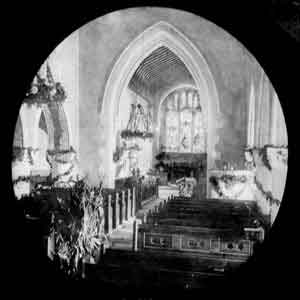
19. On our right hand is the font – This is the old original white stone bowl on a hexagonal base that in my time served for the consecration of infants to the service of the Lord – Shortly before I left the parish it was removed to make room for a NEW and very handsome “Alabaster font” presented by Mr. and Mrs. Wickham – Many a tender memory of the olden time clung around the “(Laver) of Regeneration” for me.
Slides 20 to 26
20. Before we go up to the East end I must ask your attention to the very rare moulding on one of the columns on the north side of the Nave. In fact all the Capitals of the pillars are different, no two alike; and it is not improbable that some early priest of the Church, or a Monk from Neatham Abbey, may have cut them out for his own recreation Amateur work of this kind is common in many churches – The odd part of the chapitre now before you is that it only exists on one very old church in Yorkshire. Canon Bernard, of Selborne assured me that when Bristol Cathedral tower was being built, an artist was sent into the North to copy this design – I have always fancied it to be one petal of the Heraldic Rose; but I am told it really is a fungus or mushroom.
21. The Chancel is somewhat dark being the oldest part of the Church (dating from William the Conqueror) 1075. You will notice that the arches are semi-circular (like those at St. Michael’s Southampton and like Durham Cathedral). The Capitals are all plain excepting the last one on the left hand side (nearest the pulpit). It is almost out of sight in this picture but (if you look at it next Sunday) you will notice it bears a curious pattern called “The Oxhorn
Reversed”.
22. We will now, – if your not afraid of the ladders, climb to the top of the Tower and look at the view – We are now facing East. Beneath us lies “the Play field” where the men play quoits and the boys cricket – There are two footpaths across this field – one to the right down to Hay Place and the other straight ahead to Charles Ellis’ cottage – Old John Willis who remembers the Battle of Waterloo is getting over the stile (at least he was getting over in 1886 when this snapshot was taken). Half a mile away lies the old Sema-fore Signal Station called “the telegraph”- An important place in the days before electricity was discovered – The arrival of ships at Portsmouth and Southampton being signalled from hilltop to hilltop, – until the News reached London City and Bow Bells began to ring – Far away in the distance is Alice Holt forest, and Guildford and Farnham and Aldershot.
23. Turning to the S.E. we look down upon a very interesting line of old buildings dating from the 14th or 15th Century – (of which I will tell you more presently) A newer building has been added within the memory of man and is a Village Tavern (in my days the centre of all the drunkenness and fighting of the gipsy clans at Hoppicking time and many a night have I gone out to find a woman half murdered, -but I am told these things never happen now).
24. A little further round to the S.W we look down upon the Churchwarden’s Farm, “Roxfords” -in rear of which extend the hopgardens – that little white wooden turret is an Oast or Kiln for drying the hops – Away in the background you can almost see Blackmoor (Lord Selborne’s Place) on the skyline. Selborne – Hill rises from the plain, to mark the spot were Gilbert White lived and looked about him – And, if you like the fancy, 25 miles off, behind everything lies Waterlooville.
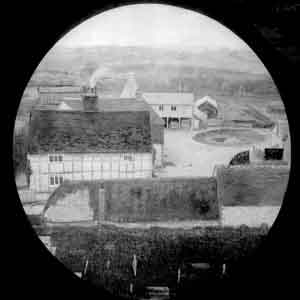
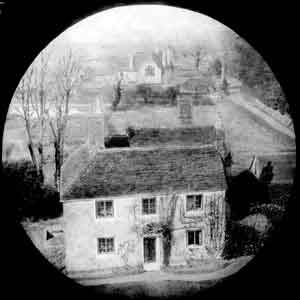
25. To the North is the vicarage a poor little place at the best but in that “Bandbox” I contrived to live for 14 years of my life – The rooms were very small and the ceilings low – Standing erect I could touch them with my hand -The kitchen was a damp dark hole, enough to depress the heart of the most courageous of cooks – and a small winding staircase (something between a ladder and a corkscrew) led to the upper floor – In going up you knocked your head against the landing after you got on to the third step; – And, in coming down, if you did not take care, on leaving the landing you stepped clear into the hail below at one bound. Of course it was impossible to get furniture up and down – We had to take out a window frame, – knock down a row of bricks on each side and carry everything up two ladders placed side by side – In this way Beds, Washstands, tables and spring mattresses were got in, – and the house wall rebuilt – But the reverse process had to be adopted when they came out again.
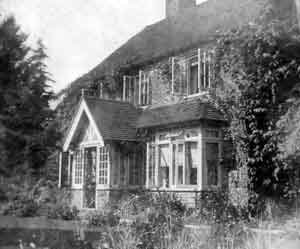
26. Here is the Vicarage from the garden. The Vine and the Virginian Creeper, and the Honeysuckle on the porch and the roses by the window, – attracted me coming from a Yorkshire town; and I settled down to a quiet life here with few regrets – at first I lived absolutely alone in that little box – The Sexton’s wife and daughter Lizzie Othen came over for a few hours every day to sweep and dust, make the one bed, and cook the chop and potatoes – of a night I used to go round all the empty rooms and lock up – after a time I got a lad in livery but he developed some bone trouble in one of his knuckles and went into Hospital and cost me half my Stipend – Then I had a series of old and incapable housekeepers, one of whom I remember fell over the doorstep and was found incapable of explaining herself – On my remonstrating with her, she said – She “thought she was coming to a gentleman; but, she found she’d come to a likeness-taker and a Lantern Man” – I’m afraid I laughed – This little kitchen maid watering the flowers is Louie Usher, who was succeeded by Sophia Dance and then boys, (Blunden) and others whom I cannot remember.>
Slides 27 to 31
27. Oh yes! One face comes back to my memory – The Boy who used to bring the “Daily Paper” – (Ernest Andrews) – He seems literary in his tastes.
27a. On the day of my arrival a tiny kitten emerged from the straw and mewed a greeting; then took up its station on one of my packing cases. I was told it “belonged to the place” so I adopted it.
27b. After a time she presented me with kittens – as the small domestic duly reported next morning. “Please Sir! I’m very sorry but I forgot to shut the old cat out last night and she’s been and laid two kittens under your study arm-chair.”
27c. Now I must call in “the Dogs” – “My dog Ben” a black setter retriever. I think the dearest old dog I ever saw in my life, gentle with the children and demonstratively affectionate. A lady friend, on being introduced to him, said “Oh he’s a dear dog because he can laugh” – and, odd as it seems, he did laugh.
27d. The children adored him – Here you see his nurse is cutting his fingernails – He had some bad habits, however – One of them was “running the Sheep” – He never bit or tore their coats; -he only wanted a game of play – He hunted them from one end of the field to the other till the poor things were ready to drop with fatigue and he never could understand that the sheep did not enjoy it as much as he did – (I’m afraid some human creatures are just as stupid as that) Beatings had no effect upon him and I should have had to destroy him if he hadn’t saved me the trouble by dying of “Heart Disease” a somewhat uncommon case (the Vet said) – A Chinese Chow Dog I got in place of him “Woo-Wong” brought me into worse trouble still; for he bit a little girl through the leg which cost me £5 in Doctor’s bills and nursing.
28. After that I gave up “Dogs” and took to “Children” – In the dinner hour the school children would run in and help me in all sort of ways – a favourite amusement of ours was “Building tents on the Lawn” – we built 4 sizes – The tiny baby tent that even Liliputians couldn’t get into without going down on all fours. This is Mrs. White’s Baby from Southay.
29. The betwixt tent & between tent in which children of eight and nine years could just sit upright. The little Patricks are playing at “gipsies” and have laid hands on all of the baskets out of the tool house. Ah! and “Ben” is “laughing” to oblige the Company and show he can do it.
30. Then there was the “really respectably sized tent” – almost large enough for camping out – Mr. Policeman is doing a little shooting whilst the wife minds the baby – “Nelly” (something or other) I forget her name but she lived opposite the Chapel door. Was it Constable Nicholson in those days? I rather think it was.
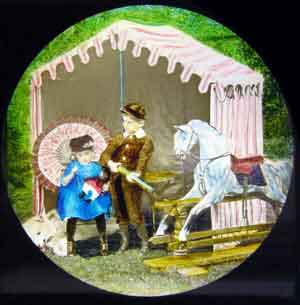
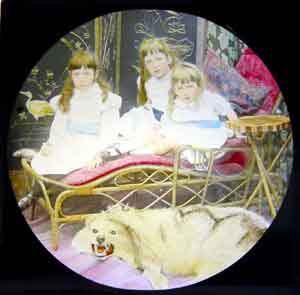
31. Often children came to my gate and said “Please we’ve come to be took” – to which perhaps I would reply “How will you be took?” “Oh! Anyway” – “Well then! Take care you aren’t took bad” Three little maidens appeared so daintily dressed (I fancy their mother had been schoolmistress at Worldham before she married and went to London) and they looked so perfect and sweet that I tumbled them all in a heap into my basket chair and put the “grey wolf” at their feet and I thought that “angelic”.
Slides 32 to 42
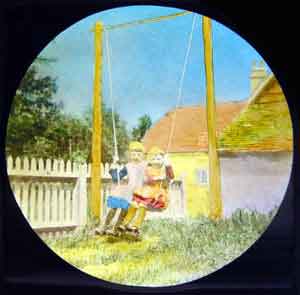
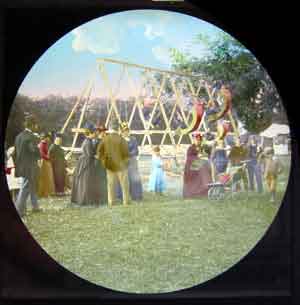
32. There was a “swing” at the back of the house, big enough and strong enough to carry two little maids at once. These are the Sergeants’ children from the Public House at Black Nest who have brought “Father’s papers to be signed please”.
33. But instead of hauling all the children in one at a time it will be quicker work to go down to the school and see them as they come trooping out at 12 o’clock.
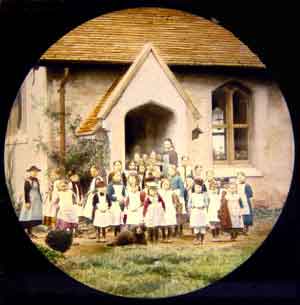
34. Mr. Bulbeck was schoolmaster in those days; – and the school treat was held in the Rectory Close; – and
35. our Lambkins skipped over the grass and ran races and at last stuffed in cake till they “bust their buttons” and couldn’t see out of their eyes – Of course they don’t do these things now. They come in Kid gloves and they are too genteel to run and they say “Only one piece of cake please teacher”; I’m such a dreadful dyspeptic; – but I know all my “‘ologies”.
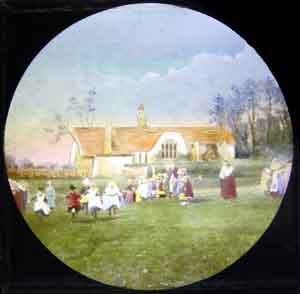
36. The annual club feast used to take place in the same meadow, when the Swing boats came and the band played and somebody danced.
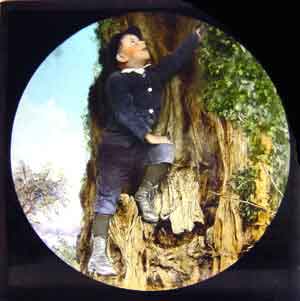
37. In one corner of the field, just as you went out of it along the footpath to Wyck, there stood an old fragment of a Yew tree upwards of a 1000 years old (I don’t mean the full grown Yew tree in the middle of the Churchyard – That has only been there about a century and a half. I mean a crumbling old stump that has rotted away to its very heart and is now hollow like a decayed tooth; but there is life in it still and every year it throws out fresh shoots above – A verdant bower of ivy loved by small birds (as a nest building nook) loved likewise by small boys for the same reason – Hullo (little Collins) mind you don’t fall..
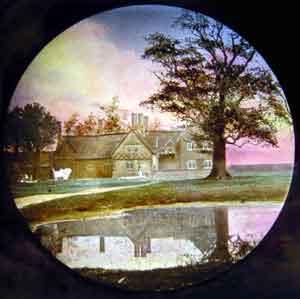
38. The dear old rectory stood in this field when I came to the parish in 1881 – a perfect picture of rural English country life, – with its gables and clustering chimneys – “a thing of beauty” and a “joy for ever” – Here the Bulbecks reared their brood and here below the surface were vast cellars in which (it was whispered) 100 years ago stores of smuggled liquor and goods “from over the sea” lay “hid” till the “Preventive men” had ceased to patrol the roads – It was pulled down under a faculty from the Dean and Chapter of Winchester; because it was getting past repairing and it might have cost a fortune to rebuild.
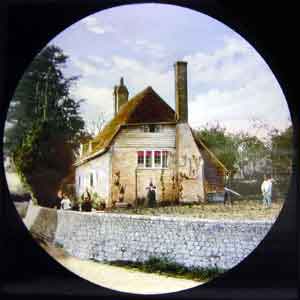
39. Thomas Othen’s Cottage – Sexton and Captain of the Ringers all the 14 years of my being in charge of the church and parish – and Mrs. Hall a sister of Mrs. Othen’s and the two children Lizzie and Ada with their mother in the garden.
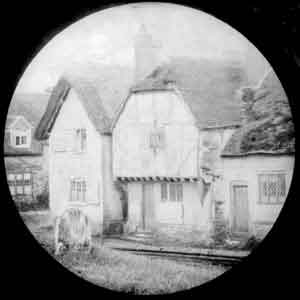
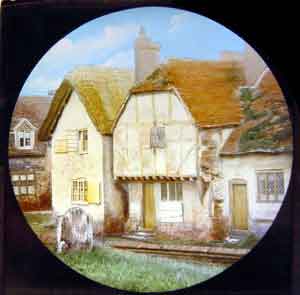
40. This is the cluster of Old Buildings we saw from the top of the tower. That “tumbled down old place” (as it looks to you no doubt) is a priceless relic of the past; – built partly of timber and partly of brick it is a fair specimen of old English work – It certainly dates from the XVth century -I have heard one enthusiastic antiquarian claim for it that it probably goes back to the XIVth century – If that be so, we may construct a very pleasing conjectural history of that old house – If it really is 500 years old, – it would be interesting to think that it was erected by some soldier returning from “The French Wars” – In the reign of Edward IInd soldiers went from “Benestede Parish” to fight at Crecy in 1346 and ten years later under the Black Prince at Poitiers – Of course it has had a new roof from time to time, – but the walls and floors are intact and the old oak joists are still sound.
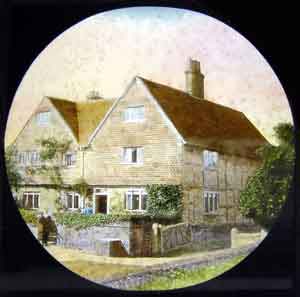
41. We go on to “Roxfords” – Churchwarden Andrews comes out to meet us followed by his daughter – It is said that he was “a rare fighter” in his youth, – “Once knocked a gipsy back’ards over a fi-bar-gate never would stand no nonsense ‘e wouldn’t.” – He is a fine old man and looks capable of it – very fond of “Racing” in the days when the money was plentiful, drove a pair to “Good wood” and mucked with the old Earl of Stamford.
42. But now he is breaking up fast, poor old chap – His chief amusement is putting the dog through his tricks.
Slides 43 to 53
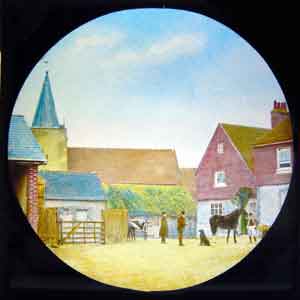
43. We look in at the back yard to see one of his horses that has gone a little lame in the off foreleg – things used to hum in the old days when Hopgrowers made £1,000 by their years takings; now a man can hardly pay his rent.
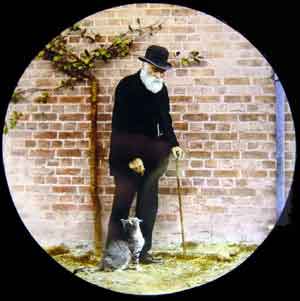
44. As the infirmities of age crept on him, – I often met him sauntering along the South Wall with “Jem” the tabby cat, – as his most faithful companion.
45. His Portly Wife, too, had a Devoted Admirer in “Sam” the rough coated but warm hearted terrier dog; who liked his mistress none the less because her pockets sometimes contained odds and ends of biscuit.
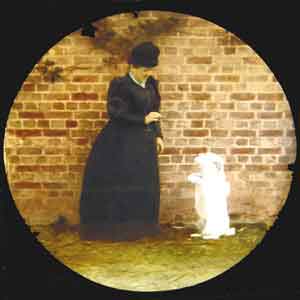
46. The “House boy” at the farm was a bit of a “soft headed sample” – We called him “Silly Billy” – The other lads used to play all sorts of pranks with him. The grocer’s boy says “open your mouth and shut your eyes; and you shall have a sweet suprise “whereupon he gets a good wedge of candle to chew. Next day he brings him his portrait “Soft Soap” – Poor Silly Billy immortalized himself by saying to his mother “When I die, – Don’t bury I, but stuffy I, and sticky I up in the corner for a himage”.
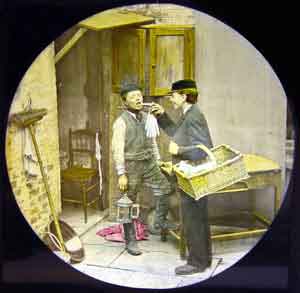
47. We ought to now go and pay our respects to “Churchwarden Langrish” – Our way lies along this little lane sunk deep between its high malm banks – The soft rock crumbles very fast and our forefathers never thought of putting “metal” on the roads – when the mud was more than a foot deep, they came with spades and carts and gathered it up and manured their meadows with it – Thus the track sank deeper every year and in winter time the roads became water courses. Foot passengers clambered up the bank and walked along inside the hedge – Hence you find a road and a footpath running parallel for miles at a stretch.
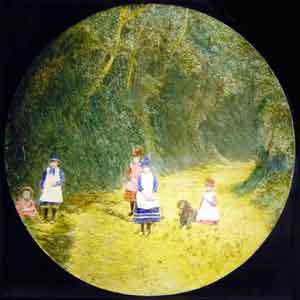
48. We pass a hollow tree on our left, which becomes “a Haven in a Storm”. This little couple set out for a ramble without hats or cloaks trusting to the deceptive inspection of the sky. Half an hour has brought on a “thunder shower” – and they have been obliged to run for it – One comfort is that thunder rain in Summer is soon over.
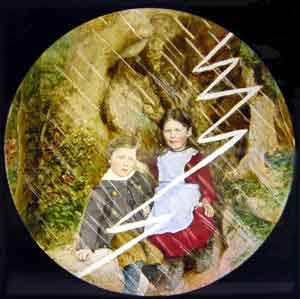
49. Our way lies through a little valley and up the opposite hill – The springs in the hillside sometimes open up a hole big enough to put a cart and horse into (I have been told). This view was taken from the “foot-path to Wyck” (not from the lane). One time the whole of these hills were covered with Oak forests grown by government for the “Wooden Walls of Old England” – Now it is nearly all cleared and under cultivation – On the right you will see the Hop-poles piled up, and stacked for the Winter.
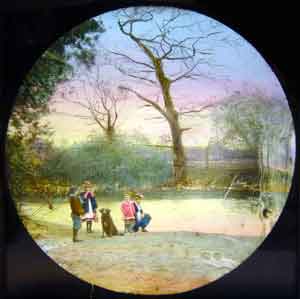
50. We are now drawing near the Hamlet of Wyck and this is The Pond. The sun is setting in the west, and I hope we may be in time for tea. Nothing like a “Farm” for home-baked bread (with a little bitter of Hop yeast in it to tempt the appetite) and home-made scones piping hot, – and rich yellow butter – and cakes many and various. – “Ben” is waiting for his bath and the children are waiting to see him bring out a stick in his mouth -In the “Hoppicking” we pitch a tent in yonder field and serve out gallons of tea to the gipsies.
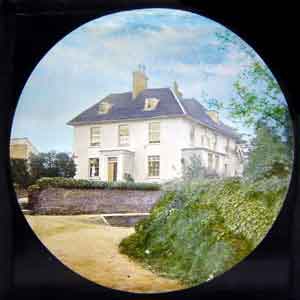
51. Here is Churchwarden Langrish’s House; – very substantial (like himself). “Standing four square to every wind that blows” – A House where you feel sure of a warm hearth and a warm welcome; – Nothing pretentious, – but all solid and good, plain, homely and comfortable – Oh those “good old days” of sturdy English life; – One sighs after them, never to return.
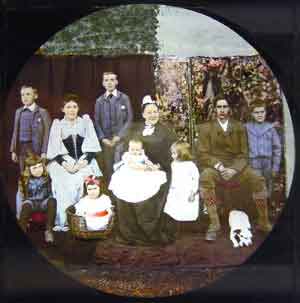
52. And here is “the master” Himself, – with his special pet “Kathleen” – I overheard her crooning to herself one day, – as she danced slowly from foot to foot, – “I is a pretty little girl! I is! Bless my little Heart”- We can easily see where she learnt that from! He was “Fond Father” to all his children (and he had 11 of them) but Kathleen was the light of his eyes – Here are “the family”.
53. They make a tidy group and yet two of them are absent; – One because she was away on a visit and the other because he wasn’t born at that time – I think that Mother was one of the sweetest women I ever knew; and all the young people healthy in body and wholesome in mind from the eldest to the youngest – And now seldom can you say that of an entire family.
Slides 54 to 64
54. This is the “Baby Boy” (who I say failed to put in an appearance in the last picture, because he wasn’t born) -I believe he is now a fine lad in an Eton jacket at a public school; – but when I saw him last he was hurtling round the garden on his “Bicycle horse” (as he called it though it had three wheels) making prodigious noises with his mouth supposed to be provocative of accelerated speed on the part of his “gee”; – and distending his fat cheeks with the effort to propel himself along.
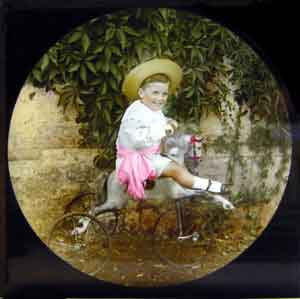
55. Lessons over the (Eessbys) little feet are soon tripping er the lawn playing at horses, – running a race and jumping over the beds; – And when thoroughly tired out, – they come to a standstill in a shady corner of the garden, – where
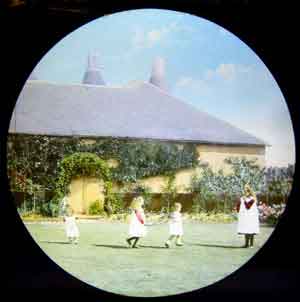
56. grows a tree much sought by the younger Churchwardens; – because from its leafy boughs a black rain comes pattering down in delicious Mulberries on the path below.
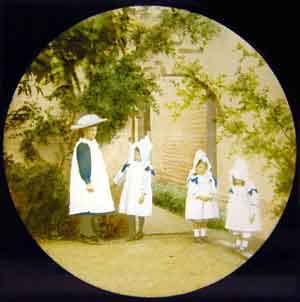
57. The Coachman’s children, were to me quite as sweet (in their way) as my other little friends -Here are Edith and Willie and Freddie Collins and “Ben Collins” of course; for Ben has a hundred surnames and no child in the parish but declares him to be his “own own brother” and Ben always agrees.
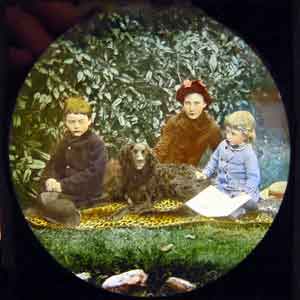
58. And here is “Collins himself” and the “Chestnut” (as large as life and “very much alive” at that!!!) We’ll ask him to drive us over to Kingsley to call upon the Vicar whom we have been neglecting all this time – But first we must cross the road.
59. “Binsted Wyck” is the Mansion of the late Mr. Wickham, Chairman of the Bench of Magistrates and Member of Parliament – I am sorry that the picture is rather indistinct; but that is the fault of the photographer. You can see at a glance the old part of the House and the later additions. The chief interests about those terraces is that they were an Old Roman Camp; – The name Wyck being a corruption of the Latin ‘Vicus” or Roman Villa.
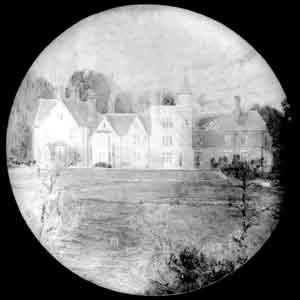
60. If we cross the Ravine and climb the other side of the hill we shall get an idea of the height of the building above us – The Drawing-room windows are facing us, – one bay to the right and one mullioned window to the left of the angle of the house wall.
61. There is a pretty little Fernery with a fountain playing into a Fairy Shell and a tiled walk up the centre – Mr. Wickham was a great Botanist and planned this charming home for his favourite Jesus.
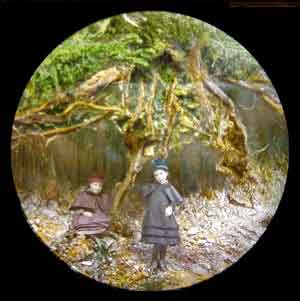
62. And now we are free (if Mr. Collins is ready) to visit the Vicar – On the way we pass a little bower under the roots of a big tree, where Emily and Nellie Gregory are hiding on their way back from school – The great roots find their way down through the cracks in the soft malm rock; below that they cannot penetrate into the gault; they knot and gnarl themselves like twisted snakes – And when at length the summer sun and winter frost pulverises the soft substance and it tumbles to pieces, the roots of the tree are left bare and form rustic arches by the roadside.
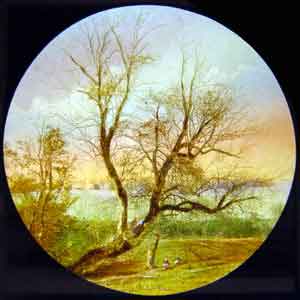
63. There are some fine trees in the meadow on the right; one stately oak stands fully 40 feet towering upward like a “Forest King,” – looking down with scorn and contempt upon the Common herd that only attain to five and twenty feet.
64. Nearby is a most singular freak of nature called “The Siamese Twin” growing out from the side of the bank as an acorn shoot, – it found it necessary to twist its head round before it could see the sky and in the attempt it got a little confused in its mind; – the result being that it threw out two heads instead of one – And so it has been, ever since, practically two trees growing from one root – Somewhere near here is a footpath leading to “Miss Powell’s Farm”.
Slides 65 to 75
65. A little bridge leads little feet across a little brook; almost a ditch; – but what a picture it makes – And Nellie and Ernest Vidler with Ernest Andrews (grown bigger since he fed so much on Politics) are happy litle rascals to live in so fine a country, – smiling with good nature and ruddy with health. It is almost worthwhile to surrender riches and learning and position to be able to go whistling along life’s way (with one’s hands in one’s corduroys) without a Care in the World.
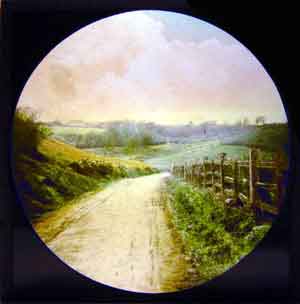
66. From all points this lane is picturesque; – And the land on both sides the way is very valuable – Binsted lies on the “Upper Greensand” (just below the chalk which has been all washed off here) now Kingsley lies on the “Lower Greensand” (under the gault) both will grow hops; but the upper stratum is a far superior soil for that capricious plant – The higher stretches in this picture are the “Upper Greensand” and those wet marshy meadows down below are heavy clay, on the gault, and comparatively worthless – Hay Place can be seen on the far hill and Southay lies behind our back.
67. Kingsley old church is passed on the left – It is now only used as a Burial ground – It is a terrible old barn, eaten up by mould and mildew – You could write your name in a sticky green lichen all over the flags of the nave – It is somewhat improved when seen in the “twilight” of a summer night.
68. A Bright Little Sanctuary has been erected on Kingsley Common about half a mile further on -We see it in the afterglow of the sunset.
69. It is worth going into (late as is the hour). Let us enter by the South Door.
70. The interior is in the Butterfield style of architecture -“ornamental bricks” – I ought to explain that early in the reign of Queen Victoria Alton Church was the centre from which all these churches were worked. In 1839 old Dr. James, Vicar of Alton had “£4,000 a year” and kept 4 curates to each of whom he gave £80 a year to work his six outlying parishes for him – At his death these “Daughter churches” were made into separate parishes – Kingsley and Binsted were at that time too poor to support a clergyman apiece; so they were bracketed together “Binsted Cum Kingsley.”
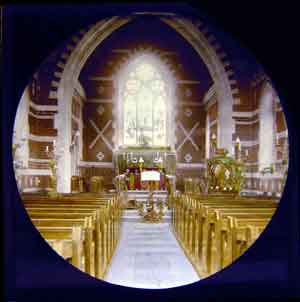
71. Let us go over and see the Vicar. There is no “Vicarage”, but this is the house where I found him living in 1881. As his income increased he started a Dogcart with one horse and drove “Old Sultan” himself – Fishes rose; and he engaged “a coachman”; his “titherent charge” swelled to four figures and he invested in a “pair”.
72. But here is the old gentleman himself! The Revd Charles Bingham Walsh, educated at Trinity College Dublin (and I needn’t tell you an Irishman “bred and born”) He kept his “Jubilee” after he had been 50 years in the parish and he frankly told us that when he was ordained he had only £80 a year and yet he married a wife and began to rear a family – when the living was given to him it was only worth £150 per annum; but when hops began to be planted it went up by “leaps and bounds”.
73. In the village there is a large middle class educational establishment, founded by the daughter of Judge Lushington) and called by “The Ockham Schools” (after their Father’s old home in Surrey) and here you may get well trained for £20 a year if there is a vacancy.
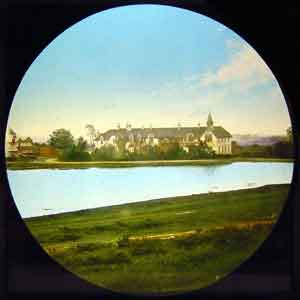
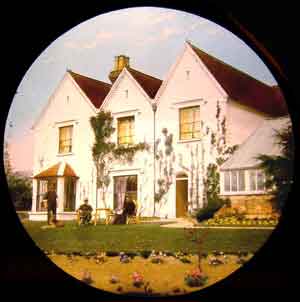
74. On the way back to Binsted we will go by Wheatley House, the Residence of H. Wheeler Esq. At the time this photograph was taken Mr. and Mrs. Lee and their daughter, Mrs. Chapman (with a grandchild) were living in the place as tenants.
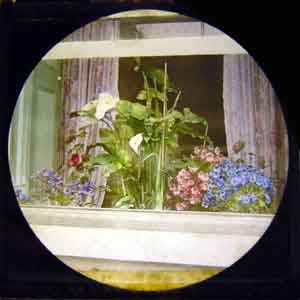
75. They had some very beautiful arums and cinerarias in the drawing room window – I remember.
Slides 76 to 86
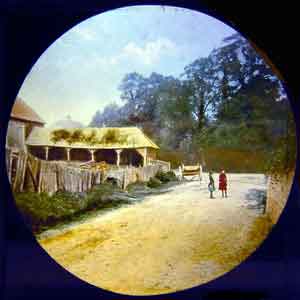
76. Outside the old farm buildings look like that “dear old world” which is so fast vanishing away and the carter took me aside to tell me “they boys” was the plague of his life -“Never would let a hoss alone – sensible creatures they be: left to ‘emselves – (Not the boys, course; but the hosses)”.
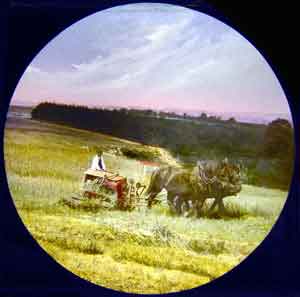
77. A field of oats was being reaped on the right hand side of the way, as I came homewards and the machine hummed and whirred like a gigantic grasshopper far away over the sloping ground.
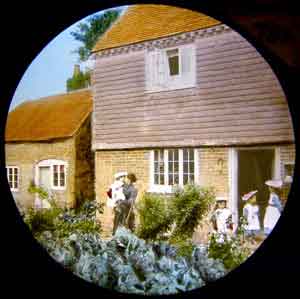
78. Passing up the street, I found Mrs. Dawes had her little grandchildren down from London (in the old house where many a farmer of today went to school). In the little cottage adjoining Mr. Samuel Pamplin passed away, after he retired from the Post Office.
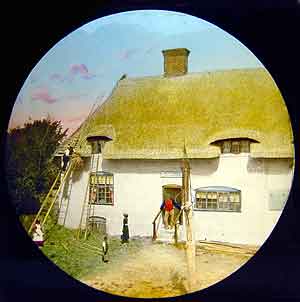
79. And now Mr. Harry Barnes in his crimson waistcoat awaits us at the shop door and the “Village Pub” – many a scene have I witnessed in the open space in front of the door and many a time I nearly got knocked on the head by a band of excited gipsies – Though as a rule I was “best of friends” with them all – But in a stand up fight look out for your head! Here old “Major Ayres” had his ribs broken and the Frankhams paid £5 at Alton for dancing on his chest – Here I went, before church one Sunday morning to deliver a note, and two thirsty souls called out “Ah! ‘e’ll open for Parson! Come on!” but he didn’t; and they went away disappointed. These old “thatch roofed” cottages are fast disappearing from our lands – I was dining at a friends house one night – when 13 cottages were burnt down within the hour -charming to the eye as this old inn – but they have never been rebuilt.
80. It was at Weston Patrick (near to Odiham) The engine arrived on the scene when all was over: And the hose was got out and a stream of water thrown on the burning pile; but it was too far gone to do any good and it might have been left to burn out of itself.
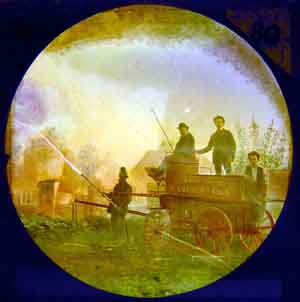
81. However the Firemen looked very smart in their brass helmets and the captain was a magnificent figure of a man. And they marched about from one burning heap to another and looked very important.”
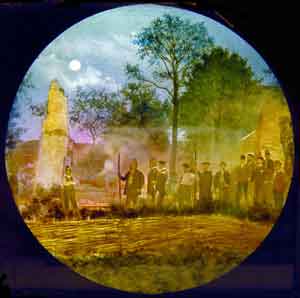
82. And all the boys and men turned out and warmed their hands and kicked sparks out of the smouldering logs; and everyone enjoyed himself to his hearts’ content; – except the poor creatures who lost their “little all”.
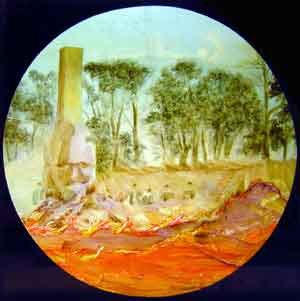
83. Next morning the village was “in ruins”; – blackened walls, and old chimney stacks, standing bare to the sky (where cosy life had nestled together and the family had warmed itself at the hearth) Too sad for words.
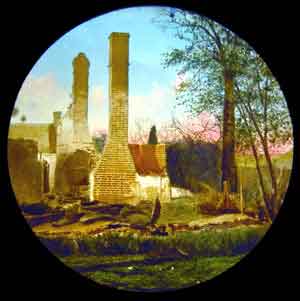
84. And thirteen households were without a roof over their heads – Such distress and despair I never have seen (and as I say) these cottages have never been rebuilt.
85. We have tramped a pretty long way – But, if you are not tired, we will “step round” by Westcourt and Millcourt and Froyle and Frensham and Farnham; – “Only a little way” -So cheer up – “the fancy flies” without fatigue. “The sheep fold” at the back of the church and schools belongs to George Langrish Esq. – you can see (to the left) the roof of Mr. Daniel Inwood’s Farm called “Binsted King’s” (the original holding under the Norman Crown).
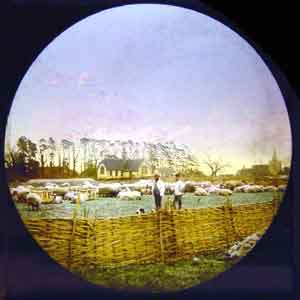
86. The shepherd (Mr. Daniel Clements) and his son stand by the “turnip cutting machine” and a “Dish 0’ Mangles” is always ready for the “hungry multitude” about dinner-time -one seldom thinks of the shepherd, out in the cold night and the rough weather; – but he is a “power” on a farm and he has to be “father, mother, nurse and Doctor” to his woolly coated family.
Slides 87 to 97
87. Westcourt looks like an old Manor House – Some people have thought it may have originally belonged to the Crusader Sir Richard De Bere Westcott – It afterwards passed by marriage to Sir Richard Hayes (from whom “Hay Place” took its name as well as South Haye). It is now the property of the Wheeler’s. A curious little bit of coloured glass in the window by the font (but before the restoration in the east window) displays the arms of Sir Harry De Wallop (First Lord Portsmouth) with mermaid supporters clad in seaweed – I know not if we may here trace any connection with the Westcott’s; – but the old Forest of “Bere” extends from Portsmouth to Hambledon, the early home of English cricket and the capital of the district as the name shows (Haemeldune).
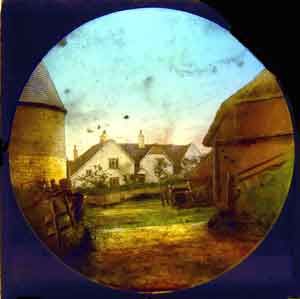
88. In the farmyard in front of the house sheep-shearing is going forward – It looks a very uncomfortable process (at least for the sheep). How should we feel if when we went to have our hair cut, – the Barber seized us by one leg, – threw us down on the ground, – put one knee upon our stomach and with the other gripped our neck, – whilst he started shaving off our beautiful locks with a pair of hedge clippers.
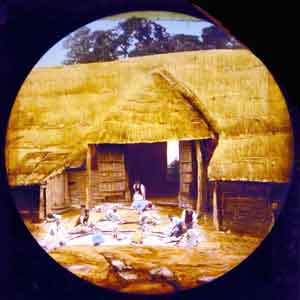
89. However it is a “high time” for the gang of shearers; and at “luncheon hour” strong home-brewed ale is served out from the farmer’s Kitchen. Pithers (in the blue cap) is the only man I recognise by name amongst them.
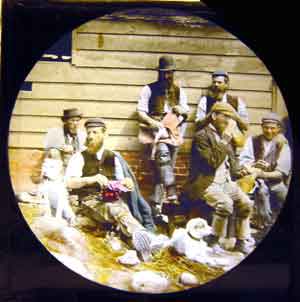
90. When the day’s labours are over the “Unmarried men” ride off on their “Bikes” waving farewell to those less fortunate “Benedicts” who find that their wages won’t run to such a luxury, – where there are 8 or 10 mouths to feed at home – so they follow “afoot”.
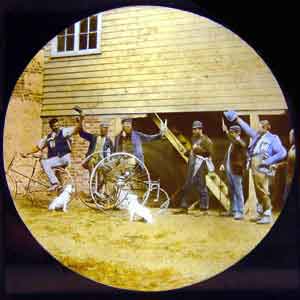
91. Here is a tempting pool for the “Angler” in the little river“Wey”, – which flows between the two parishes of Binsted and Froyle – The ruins of an old Flushing Blanket Mill long since disused, – stand as a memento of the early days of last century, – when weaving was done here – The residence adjoining on the top of the hill behind our backs takes its name “Mill Court” from this site – Possibly there was an old corn mill before the speculation in blankets was thought of.
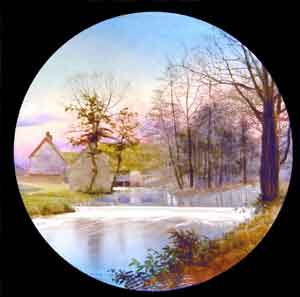
92. A little further “down stream” we come upon Froyle Mill – It used to drive a good trade I fancy; for I was at Mr. Young’s sale and bought some very good old furniture – The snow has covered the path and also the flat meadows below, where good skating can be had if an extensive overflow is followed by a frost – Two of my young friends are seen hand in hand -A school boy from Yorkshire who used to come and stay with me at the vicarage and talked of becoming my “Curate” when I should get a “living” but he died of heart seizure just after a football match – “Charlie” was a sweet boy and I grieved to lose him – The little maid is an Italian child “Nancy” to whom I became guardian and who is now married and has a group of boys herself in the north of England.
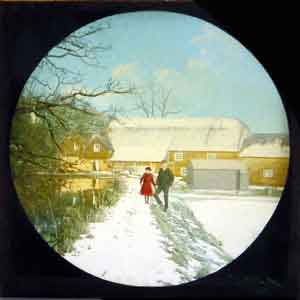
93. While the snow is on the ground let me carry you across the park to Froyle Pond at the back of the church, where all the boys and girls repair directly school is over.
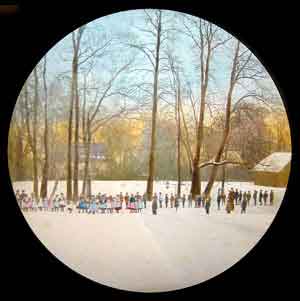
94. Froyle Park – Sir Hubert Miller’s property was in the occupation of Mr. Wood when I took the view – Mr. Floud was Vicar and Mr. Bentwick lived hard by and Mr. Apperley was at Mill Court (so that will tell you how many years it was ago) Mr. Caine followed and I remember Sir Richard Webster at Mill Court in 1881.
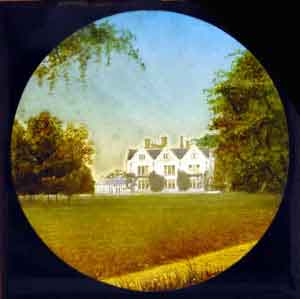
95. Froyle Church – Some of us can remember Sir Charles Miller’s funeral and all the stir caused on that occasion; but the last time I was there was to stand at the grave side of my poor friend Apperley – (what a beautiful east window that is yonder!!).
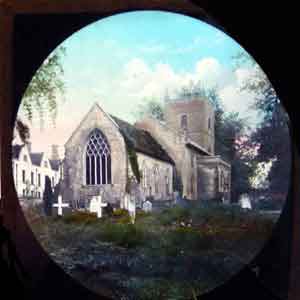
96. The Vicarage gate is on the right, just opposite the church; where Nancy used to go over to tea with her friends Enid and Patience Floud and their father followed me to the forest of Bere and became Vicar of Hambledon about 5 miles from my church. Nancy and Enid both chose the career of nursing – and the brother Harold is now curate to his father – Frank is in London.
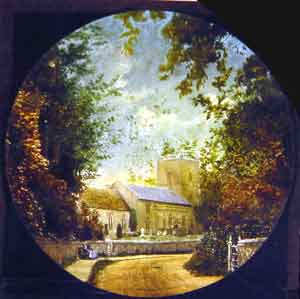
97. Lower Froyle Pond is a Recherché little scene truly English and utterly unrivalled by anything one meets with in foreign lands – Our own dear old country is the best in the world and English Villages abound in these lovely little “bits” of beauty.
Slides 98 to 103
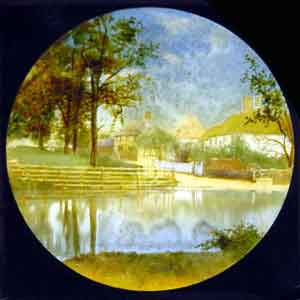
98. The lecture is drawing to a close (and so too is your patience) I should like to show you an old sandpit between Kingsley and Frensham – It stands by the roadside and has formed a “Home” for countless generations of sand martins –
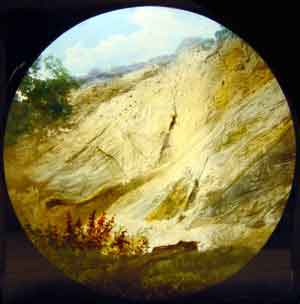
99. And here is the Famous Pond seen from afar, – an expanse of water like an “inland sea”, -lying in a dip of the old “Forest Lands” not very far from Guildford – The hills in the background are Hindhead and Hazlemere.
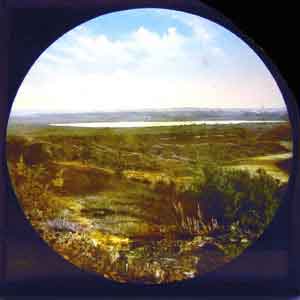
100. As we approach the Pond, it seems to diminish in extent owing to a great part of it being concealed behind the bluff of the hill on the left – The Hotel and Boathouse are before us. This is a great “Pleasure Resort” for the Officers from Aldershot, who drive over for an afternoon’s sail or for fishing.
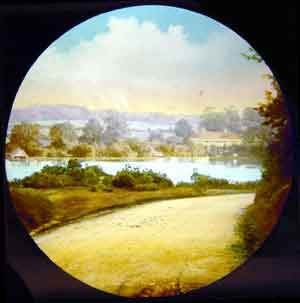
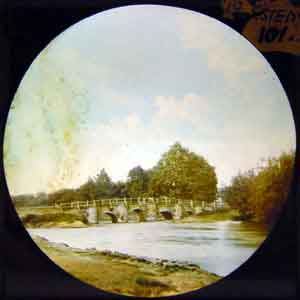
101. Tilford Bridge is often visited because of the old-oak-trees on the Village green, – which are mentioned in “Doomsday”. Unfortunately they are just out of sight behind our right shoulder.
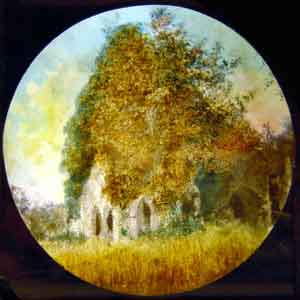
102. The Ruins of Waverley Abbey lie to the south of the Farnham Lane very calm and peaceful in their “leafy old age” – If you creep up and look in at that arched opening on the left, -through an iron railing put up to keep the cattle out, – you will see into “An Early English Crypt” with a groined roof and beside that the “Refectory” where the monks ate the fish they had captured on the banks of the Wey – This was the Earliest Cistercian Abbey in England and it was founded in 1128 by William Gifford, Bishop of Winchester – The “Annales Waverlianses” published by Gale, are said to have suggested to Sir Walter Scott the name of his first novel – from Waverley in Surrey, the first settlement of the Cistercians, they spread over Britain, especially the rivers of Yorkshire, and extended into Scotland – One chief feature of this Brotherhood which tended to make it popular was this; – that it touched both ends of the social scale – St. Bernard and the 30 novices who joined with him were all of noble birth, -And in the 12th century many German Princes entered the order – But a place was found also for the poor and the uneducated – Those who were unfit for “the Choir” tilled the fields; – the labourers who thus belonged to a “powerful religious community” felt their superiority to the mere “Serfs” of the neighbouring feudal Lord – This led the way to “the emancipation of labour” celebrated in Wordsworths’ sonnet and the “Trades’ Union” and “Labour Party” of today.
103. And now, having arrived at Farnham and the Bishop’s Castle, I must slip away – It would never do for me to go up those steps in Castle Street” with you just now – His Lordship might face me with a long bill for “Dilapidations” that are still hanging over me since I resigned my living on the 24th of June 1908. I must here take leave of you all, – with the expressed hope that this little excursion into “my old parish” and memories of “20 years ago” has not altogether wearied you -To all “old friends” I send my kindest remembrance. And to all weary heads and tired brains I bid “Good night”.