At the beginning of the 18th century there were few proper roads. There were two tracks from Holybourne to Bentley, the upper track used in winter, through Froyle past the Church, and the lower track nearer the river used in summer. As stage coaches and road waggons were coming more into use, it was necessary to construct a proper road, and so Froyle was by-passed. An old directory, about 1730, gives the route Alton, Holybourne, Bentley, leaving out Froyle, so the road must have been completed before that date. Even the present main road is not, in several places, on the exact original. From near the Hen & Chicken to Quarry Bottom, traces of the original can be seen inside the park wall, and the place where the stream was forded, before there was a bridge, can easily be traced. Probably the wall was not there in 1730, as it is supposed that French prisoners built it in the time of Napoleon.
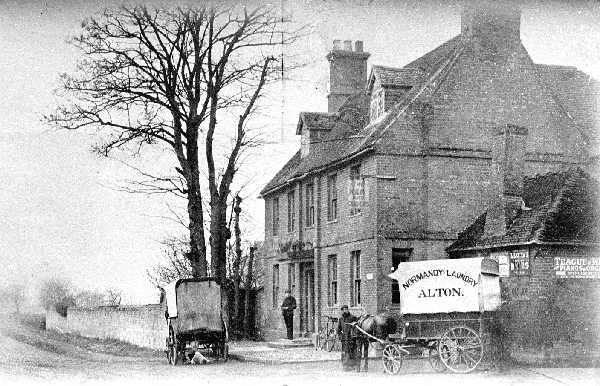
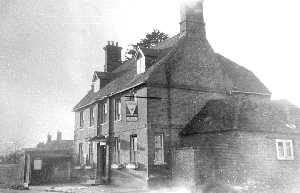
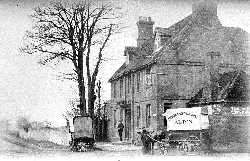
The Hen & Chicken was built about 1740 as a Chaise House where people met the Stage Coaches. For some considerable time it was called the “Hen & Chickens” – closer examination of the photograph will reveal this on the sign at the centre of the frame. The pub has changed relatively little over the years as can be seen from the right hand picture, which dates from the 1930’s.
The cottages in the distance in the right hand picture – the left hand picture is from a slightly different angle and they are not visible – are known as Turnpike Cottages and are alleged to have been the stables for the Inn. However, Christopher Hussey, in his December 1941 Country Life article describes the Hen & Chicken thus:-
“It is an attractive, little altered, brick Georgian house, with posting stables at the back……..”
The layout of Turnpike Cottages suggests that they were built as cottages, not converted from stables. The Hen & Chicken(s) was an important Post Inn on the stagecoach routes to London, where not only horses would be changed, but mail would be collected and delivered.
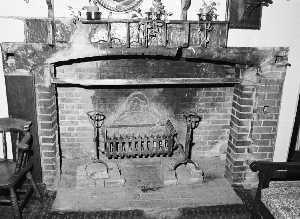
The fireplace
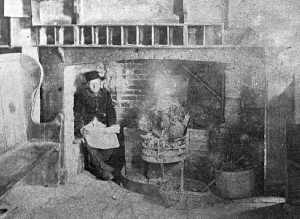
These two photographs of the fireplace in the Hen & Chicken are nearly 100 years apart. The upper shows clearly the racks that held the letters, and the benefits of an inglenook fireplace! The lower picture was taken in 1983, after a chimney fire had seriously damaged the fireplace. The Alton Herald of Friday October 21st reported:- “The fire……was thought to have started sometime on Sunday evening, but was not discovered until 7am on Monday morning by the landlady…….She found the sitting room of her upstairs flat full of smoke. Rushing downstairs to the bar she found the whole fireplace area glowing and most of the oak beams surrounding it well ablaze.” Luckily the Alton Fire Brigade prevented any further damage and the fireplace was successfully rebuilt. The elderly gentleman sitting in the fireplace is believed to be Mr Rawson, the landlord in the early 1900s. During that period the Inn became a gathering place for horse dealers and other ‘travellers’ and, occasionally, tempers would flare, and Mr Rawson, apparently had a unique way of dealing with them. Like many country people, he kept bees and one particular day, when things started to get out of hand, he brought them into the pub and set them on the ‘travellers’. That soon cleared the room! After that he only had to say “Do you want me to let my little friends out?” and peace reigned.
Then and now
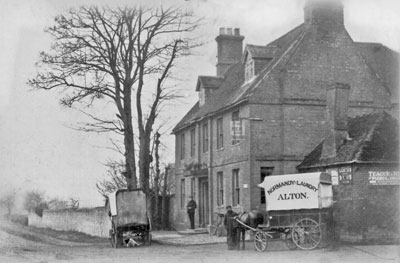
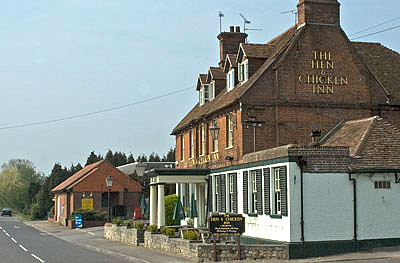
The Hen & Chicken, on the A31 in Upper Froyle, or to be precise – Froyle. The old picture was taken early in the 1900s and the modern one in March 2007. There are a quite a few visible changes between the pictures:- Additional dormer windows have been added in the roof. A single storey extension has been added nearest the camera. The entrance porch has been enlarged. The tree by the front entrance has been removed. The road has been made up and white lines added. In fact it is no longer the main A31; a dual carriageway was built to the left of the picture and the ‘old’ A31 is now a service road to the Hen & Chicken, Turnpike Cottages and the petrol station. A petrol station has been built next door.
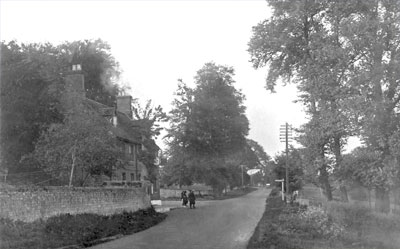
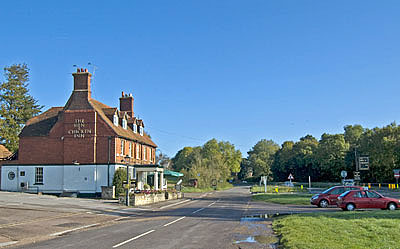
These two show the reverse angle of the pair above. The old picture was taken around 1910 and the modern one in October 2008. I have included the full frame width of the original to show where the biggest visual change has occurred. The changes to the surroundings are more noticeable from here:- The modern service road is still wider than the original main road. The trees on the right were felled in the 1960s when the A31 was upgraded. The entrance on the left nearest the camera in the 2008 picture is access to the Hen & Chicken service station.
The pub was Grade 2 Listed in May 1985. English Heritage gives the following information:-
Hen and Chicken Public House. GV II Public house. c1740, with C19 extensions. A chaise house, erected following the construction of a new coach road, c1730. Brick walls, with a tiled roof. Symmetrical front (south-east) of 2 storeys, and attic, 2.1.2 windows. Plain roof, with 4 gabled Victorian dormers. Red brick walls in Flemish bond, rubbed flat arches, 1st floor bond, plinth; a centrepiece is formed by 2 pilasters. Sashes. Tuscan porch with entablature and 2 smooth columns. A single-storeyed extension at the east side, of 2 windows, is constructed in the same style.
Information from English Heritage, Images of England
The Hen & Chicken in the 1998 Froyle Archive
The Hen & Chicken Public House
At the beginning of the 18th century there were few proper roads. There were two tracks from Holybourne to Bentley, the upper track used in winter, through Froyle past the Church, and the lower track nearer the river used in summer. As stage coaches and road waggons were coming more into use, it was necessary to construct a proper road, and so Froyle was by-passed. An old directory, about 1730, gives the route Alton, Holybourne, Bentley, leaving out Froyle, so the road must have been completed before that date. Even the present main road is not, in several places, on the exact original. From near the Hen & Chicken to Quarry Bottom, traces of the original can be seen inside the park wall, and the place where the stream was forded, before there was a bridge, can easily be traced. Probably the wall was not there in 1730, as it is supposed that French prisoners built it in the time of Napoleon.
The Hen & Chicken was built about 1740 as a Chaise House where people met the Stage Coaches. For some considerable time it was called the “Hen & Chickens” – closer examination of the photograph will reveal this on the sign at the centre of the frame. The cottages known as Turnpike Cottages were originally the Hen & Chicken stables.
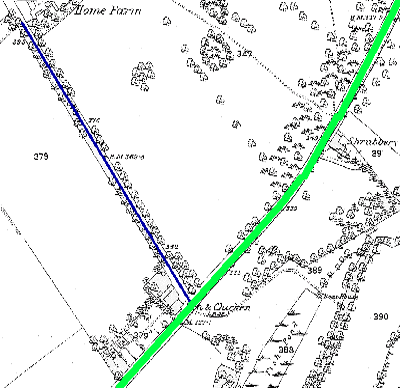
Until 1860, the way into the village from the main road (coloured green) was through Gate Lane, or Gid Lane as it is often called, just off the top edge of the map. The Hen & Chicken was reached by a footpath through a wood. In 1860, Sir Thomas Miller had this wood cut down and the road made from the pond in Upper Froyle (near Home Farm) to the Hen & Chicken (coloured blue on the map). He then had what was known as the Park Gates erected, and a double lodge built there, intending to use Gate Lane as a private drive. The authorities at the time would not allow him to close the lane, so the iron gate was never hung. It lay in Blundens farmyard for many years. This gate weighed 7cwts., and was collected during World War 2 under the iron salvage drive of 1942. In 1998 little remains to show where the lodges were at the entrance to Gid Lane, and the pond, long disused, was made into a grassed area to commemorate the Silver Jubilee of Queen Elizabeth 2nd in 1977.
Larger picture